

Table of Contents
- The Problem: Why Most Service Owners Overpay Taxes with Large Firms
- What Hands-On Tax Advisory Actually Means in 2026
- Our Proactive Tax Reduction Strategy Methodology
- Year-Round Partnership vs One-Time Tax Prep
- The Hidden Cost of Impersonal Service at Large Firms
- How We Structure Your Tax Strategy for Maximum Savings
- Quarterly Planning Sessions That Actually Move the Needle
- The Bookkeeping Integration Advantage: Data Flows, Taxes Flow Down
- Real Results: Service Owners Who Keep More of What They Earn
- Why Ed Lloyd & Associates is the Clear Choice for Hands-On Advisory
- Getting Started with Your Personalized Tax Strategy
The Problem: Why Most Service Owners Overpay Taxes with Large Firms
You’re making $2 million or more. Your business is thriving. Yet every April, you write a check that stings.
The reason isn’t that you’re bad at business. It’s that most large accounting firms treat tax strategy like a commodity. They run your numbers through standard software, apply basic deductions, and file your return. You get a bill and a folder of forms. That’s it.
We’ve spent years working with service business owners who left massive tax savings on the table because their previous firm never looked deeper. A consulting business owner paid $180K in taxes when strategic entity restructuring could have cut that by 60%. A real estate management firm missed $95K in deduction opportunities because nobody analyzed their expense patterns proactively.
The gap between what you’re paying and what you could legally save? We call that the “overpayment trap.” Large firms don’t have the bandwidth or incentive to dig into the nuances of your specific operation. They process returns. They don’t engineer tax solutions.
Here’s the tension: you need someone who understands tax law deeply, but also knows your business intimately. Someone who thinks like a strategist, not a form filler. That’s what hands-on tax advisory actually means.
What Hands-On Tax Advisory Actually Means in 2026
Hands-on tax advisory isn’t a marketing phrase. It’s a fundamental difference in how we work.
At its core, hands-on means we’re embedded in your financial life. We don’t wait until December to analyze your situation. We’re meeting with you quarterly, reviewing your numbers in real time, and adjusting strategy based on what’s actually happening in your business. If you land a major contract in July, we’re recalculating your estimated taxes and exploring timing strategies that same month.
In 2026, this matters more than ever. The tax landscape shifted dramatically with the One Big Beautiful Bill Act of 2025, and the rules around business deductions, entity structuring, and passive loss treatment are more complex. Large firms have dozens of clients. We have focus. We’re studying the implications for your specific situation, not applying a template.
Hands-on also means education. We pull back the curtain on tax strategy. You understand not just what we’re doing, but why. That might mean explaining how the 100-Hour Test works for your passive rental income, or walking you through why converting a partnership structure could unlock passive losses that have been sitting dormant.
We’re also proactive about compliance risk. Every strategy we recommend has audit resilience built in. We’re not chasing aggressive positions that sound good on paper but crumble under scrutiny. We’re finding legitimate, defensible strategies that actually reduce your tax bill.
The result? You keep more of what you earn. You understand your tax position. And you sleep better because you know you’re not overpaying or exposed to audit risk.
Our Proactive Tax Reduction Strategy Methodology
Our approach starts with a complete analysis of your financial picture. Not just your business returns, but your personal finances, real estate holdings, investment income, and any passive activities. Most service owners have financial complexity that larger firms never fully explore.
Here’s our four-step methodology:
- Comprehensive Financial Deep Dive – We collect 12-24 months of financial statements, bank records, and expense detail. We’re looking for patterns, missed deductions, timing opportunities, and structural issues that bleed money.
- Opportunity Identification – Using our tax strategist expertise, we identify 15-25 specific strategies that could apply to your situation. These range from entity restructuring to expense optimization to credit utilization to timing adjustments.
- Customized Strategy Selection – Not every strategy makes sense for every business. We evaluate each opportunity against your business goals, risk tolerance, and cash flow. We then design a personalized tax reduction plan that’s aggressive but audit-resistant.
- Implementation and Integration – We execute the strategy, document it properly, and integrate it into your ongoing bookkeeping and tax preparation. This ensures consistency and sustainability.
Throughout this process, we’re educating you. You know exactly what we’re recommending, why it works, and what it means for your bottom line.
Results mentioned are not typical and individual results will vary based on your specific situation. This information is for educational purposes only and does not constitute tax, legal, or financial advice. Always consult with a qualified tax professional before implementing any tax strategy.
Year-Round Partnership vs One-Time Tax Prep
Here’s the fundamental problem with traditional tax preparation: it happens once a year, after the year is over.
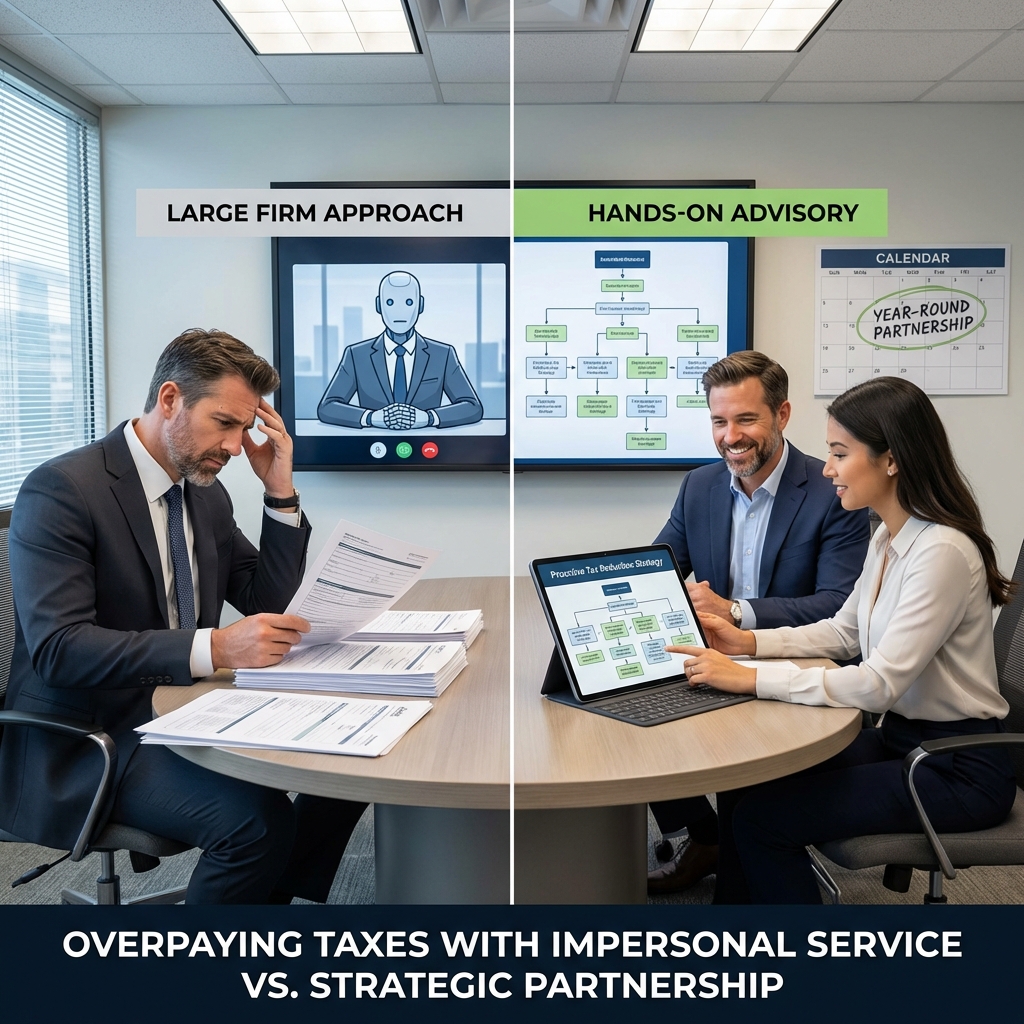
By the time December rolls around, most of your tax destiny is already written. Large firms do an excellent job filing your return accurately. But they’re working with a completed year. There’s no opportunity to adjust. No timing strategies. No proactive planning.
We operate differently. We’re a year-round partner.
In January, we set up your financial foundation and create a preliminary tax projection. In March and June, we’re running mid-year analyses to catch issues early. In September, we’re stress-testing your estimated tax payments and adjusting your strategy based on how the year is actually unfolding. In October, we’re planning Q4 moves to maximize savings. Only then, when December arrives, do we file a return that reflects a full year of strategic thinking.
This year-round approach creates three critical advantages:
- Timing Control – We can recommend when to recognize income, when to accelerate expenses, and when to make major business decisions. That flexibility is worth tens of thousands of dollars.
- Tax Surprises Disappear – Because we’re projecting your taxes quarterly, there are no April shock. You know your obligation and you’ve budgeted for it.
- Business Decisions Get Tax Input – Thinking about expanding your team? Taking on a major client? Buying equipment? We model the tax implications before you decide. That’s real advisory.
One-time tax prep firms can’t do this. They don’t have the relationship or the bandwidth. You need a partner embedded in your financial life.
The Hidden Cost of Impersonal Service at Large Firms
Scale creates a problem that most business owners never see coming.
When you work with a large regional or national firm, you become a client number. Your return gets assigned to a tax preparer who may have 60-100 clients. That person doesn’t know your business. They’ve probably never spoken to you. They’re following workflows designed to maximize billable hours and minimize errors, not to find creative tax solutions.
Here’s what that impersonality costs you:
Missed Opportunities – A large firm might process your expense report accurately, but they’ll never discover that your business model qualifies for a specific deduction you’ve never heard of. They won’t have the incentive to dig.
No Real Consultation – You get a questionnaire. You fill it out. Your return gets filed. There’s no back-and-forth strategic thinking. No “what if” scenarios. No education about your tax position.
Higher Risk – Ironically, despite being “professional,” large firms sometimes cut corners. They use junior staff for analysis. They rely on templates. When something unusual shows up in your return, it doesn’t get the attention it deserves. That’s audit risk.
Impossible Relationships – Good luck getting your assigned tax person on the phone when you have a question. You call the main number. You get transferred. You wait. For someone paying $500K in taxes annually, that friction shouldn’t exist.
The hidden cost? You’re paying premium rates for commodity service. You’re not getting the personalization or strategic depth that actually saves money. The large firm is comfortable with that arrangement because standardization is what makes their model profitable.
We’ve built a different model entirely. Your dedicated CPA is accessible. We know your business. We think about your taxes before you ask. That relationship is where real tax reduction happens.
How We Structure Your Tax Strategy for Maximum Savings
Structural strategy is where the biggest tax savings live.
Most service business owners operate as sole proprietors or single-member LLCs. That’s simple, but it’s leaving money on the table. Depending on your income level, business type, and goals, a different structure might unlock significant savings.
Let’s walk through a real scenario. You’re a consulting firm owner earning $850K in net income. You’re paying self-employment tax on nearly all of it. By restructuring as an S-Corporation and paying yourself a reasonable W-2 salary (let’s say $400K), you reduce your self-employment tax obligation by roughly $45K annually. That’s a structural move, not a deduction shuffle. It’s permanent. It scales with your income.
That’s just one example. Other structural levers include:
- Entity Selection – S-Corp vs. C-Corp vs. Partnership structures have radically different tax outcomes. We model all three.

- Holding Company Architecture – For service owners with real estate, investments, or multiple business lines, a holding company structure can shield income, create deferral opportunities, and protect assets.
- Passive Activity Management – If you own rental properties or have investment income, we explore how to convert passive losses into active losses through material participation or entity restructuring. That unlocks deductions you can’t otherwise claim.
- Timing and Exit Positioning – If you’re thinking about selling your business in 3-5 years, we’re structuring today’s decisions to minimize the tax hit when that exit happens.
This is where our tax strategist credential matters. We’re not just preparing returns; we’re engineering your tax life around your business goals.
Quarterly Planning Sessions That Actually Move the Needle
Our quarterly tax planning sessions aren’t check-in calls. They’re working sessions where real strategy gets made.
Here’s what a typical quarterly meeting covers:
Financial Performance Review – We compare your actual results to the projection. If you’re ahead or behind, we understand why and what it means for your year-end position.
Estimated Tax Adjustment – Based on updated performance, we recalculate your quarterly estimated tax payments. This prevents both underpayment penalties and overpayment.
Opportunity Assessment – Every three months brings new context. We’re asking: What major expenses are coming? Is there timing flexibility? Are we ahead on income goals? Behind? What does that mean strategically?
Tax Law Updates – We’re monitoring regulatory changes and assessing how new rules apply to your situation. In 2026, this is critical. Tax law is shifting. We’re ensuring your strategy stays compliant and optimized.
Action Items – Every meeting ends with concrete next steps. “We’re going to accelerate Q4 revenue recognition.” “We’re moving that equipment purchase to January.” “We’re setting up a SEP-IRA contribution.” These aren’t suggestions. They’re strategic decisions with tax implications we’ve calculated.
The cumulative effect is enormous. Over a year, quarterly adjustments and proactive moves compound. Business owners working with us typically see tax reductions that one-time preparers simply can’t find.
The Bookkeeping Integration Advantage: Data Flows, Taxes Flow Down
Here’s something most business owners don’t realize: bad bookkeeping creates invisible tax leaks.
If your bookkeeper categorizes expenses incorrectly, misses deductible items, or doesn’t track certain business activities properly, your tax return is built on a shaky foundation. You’re overpaying because your data is incomplete or inaccurate. And ironically, you might not know it.
We’ve solved this by integrating our bookkeeping service directly with our tax strategy and preparation work.
Here’s how it works. Your dedicated bookkeeper maintains your financial records in real time. Monthly, you get detailed Profit & Loss, Balance Sheet, and Cash Flow statements. Bank and credit card transactions are reconciled. Expenses are categorized accurately. That data flows directly to our tax strategist and preparer.
Why does this matter?
Tax Strategy Is Built on Real Data – When we’re analyzing your tax reduction opportunities, we’re working from accurate, current financial statements. We’re not making assumptions. We’re seeing exactly what you spent, where you spent it, and what’s missing.
Quarterly Adjustments Have Context – When we review performance in our quarterly sessions, we’re not asking you to pull together numbers. We have them. We can analyze trends, spot opportunities, and make recommendations with precision.
Tax Preparation Is Efficient and Accurate – By the time we’re preparing your return, the heavy lifting is done. The data is clean. The deductions are captured. We’re not hunting for missing receipts or arguing about categorization.
Audit Resilience – Good bookkeeping is your first line of defense against audit risk. Every deduction is documented. Every entry is justified. If the IRS questions something, you have a paper trail.
Think of it this way: bookkeeping isn’t overhead. It’s the foundation of every tax strategy and tax reduction we implement.

Real Results: Service Owners Who Keep More of What They Earn
We don’t measure our success in return complexity. We measure it in dollars kept.
Over the past five years, we’ve worked with service business owners across consulting, professional services, management, and specialized contracting. Here’s what we’ve seen:
A consulting firm owner with $2.2M in revenue and $680K in taxable income restructured as an S-Corp and implemented targeted expense optimization. Year-over-year tax reduction: $67,400. That wasn’t a one-time windfall. It’s structural. It repeats every year.
A professional services partnership with three principals faced significant self-employment tax exposure. We implemented a holding company structure to separate business income from investment income, then optimized the entity selection for each stream. Combined tax savings across the three principals: $142,000 in year one alone.
A management services business owner had been operating with incomplete cost tracking and missed deduction categories. We cleaned up the bookkeeping, identified $185K in previously uncaptured business expenses, and redesigned the entity structure. Result: $58,900 in annual tax savings, plus recovery of prior-year deductions through amended returns.
These aren’t typical outcomes. They’re examples of what’s possible when hands-on strategy meets a business owner ready to take action. Results mentioned are not typical and individual results will vary based on your specific situation.
Why Ed Lloyd & Associates is the Clear Choice for Hands-On Advisory
You have choices. Large firms. Solo CPAs. Online tax services. We understand why the decision feels complicated.
But here’s what separates us: we’re built specifically for your situation.
We focus exclusively on service business owners with $2M+ in revenue and $500K+ in taxable income. That’s not a side line for us. It’s our entire practice. We understand your business model, your income structure, your complexity. We’ve solved your problems hundreds of times before.
We combine deep tax expertise with real strategy. Our team holds CPA credentials and specialized tax strategist certifications. We stay obsessed with tax law changes and their implications. But we’re not theory-focused. Everything we recommend has a concrete business outcome.
We invest in your relationship. You get a dedicated CPA, not a rotating cast of junior staff. You get quarterly planning, not annual surprise bills. You get education, not just forms. You get access when you need us.
And we’re obsessed with results. Not return accuracy (though we’re meticulous about that). Results. How much did we reduce your tax bill? How much more of what you earn did you keep? That’s how we measure success.
We’re not the cheapest option. We’re the most effective option for service business owners serious about controlling their tax destiny.
Getting Started with Your Personalized Tax Strategy
If you’re ready to stop overpaying and start building a real tax strategy, here’s how we get started:
Step One: Initial Consultation – You’ll meet with our lead strategist for a 60-minute deep-dive consultation. We’re analyzing your current situation, understanding your business and goals, and identifying preliminary opportunities. This is free. We want to understand if we’re a fit before you commit to anything.
Step Two: Financial Document Collection – We’ll ask for 12-24 months of financial statements, tax returns, and business records. We’re being thorough here because the depth of our analysis depends on the quality of our data.
Step Three: Comprehensive Tax Analysis – Our team will conduct a full analysis of your financial picture, identify tax reduction opportunities, and prepare a detailed recommendation. We’ll model scenarios, show you potential outcomes, and explain exactly what we’d do and why.
Step Four: Strategy Presentation and Decision – We’ll walk you through our findings, answer questions, and present a clear path forward. If you want to proceed, we’ll establish a service relationship and begin implementation.
Start by reaching out for your complimentary consultation. We’ll pull back the curtain on where you might be overpaying and show you what’s possible.
This information is for educational purposes only and does not constitute tax, legal, or financial advice. Always consult with a qualified tax professional before implementing any tax strategy. Results mentioned are not typical and individual results will vary based on your specific situation.
Ready to Cut Your Taxes – Schedule a game plan review and see how much you can save – https://join.elcpa.com/vsl-2

Recent Comments