

The Tax Overpayment Problem Service Owners Face
You run a successful service business. Revenue is strong, profit is real, and yet every April you stare at a tax bill that feels like punishment for working hard. Service owners consistently overpay by thousands, sometimes hundreds of thousands, because the traditional tax model is broken.
Here’s the brutal reality: most business owners file their returns based on what they earned, not on what they’re actually allowed to keep. The IRS doesn’t require you to pay one cent more than the law demands. Yet the average service business owner with $2M+ in revenue leaves between $50K and $200K on the table annually through missed deductions, poorly structured entities, and unaggressive tax planning.
The problem isn’t ignorance. It’s that most accounting firms operate reactively. They wait until December, gather your numbers, file a return, and call it done. Meanwhile, the real tax-saving decisions happen throughout the year. By January 15th, it’s too late. The money is already gone.
We built our entire practice around a different premise: your tax bill should be the result of strategy, not accident.
Why Most Accounting Firms Leave Money on the Table
Standard accounting firms offer competence, not optimization. They’ll file your return accurately. They’ll catch the obvious deductions. But they won’t fundamentally restructure your tax position because that requires proactive planning, technical depth, and a fee model that aligns with your savings, not their hourly billing.
Consider what typical firms focus on:
- Filing returns on time (compliance, not planning).
- Organizing basic business expenses (bookkeeping, not strategy).
- Answering questions when you call (reactive, not proactive).
- Following what you tell them happened (historical, not forward-looking).
The gap between “compliant” and “optimized” is vast. Compliant means you followed the rules. Optimized means you structured your business and compensation within those rules to minimize what you owe.
We’ve reviewed hundreds of service business returns prepared by other firms. Common oversights include:
- Unused retirement contribution strategies (Solo 401k, SEP-IRA) that could shelter $60K-$100K annually.
- Suboptimal entity structures (S-Corp vs. Sole Proprietor vs. C-Corp) costing $15K-$40K per year.
- Material participation issues that convert passive losses into active ones, unlocking real deductions.
- Underutilized business expense categories (home office, professional development, strategic gifts).
- Missed tax credits specific to your industry or situation.
Here’s what’s critical: identifying these gaps requires someone who thinks like a strategist, not just a bookkeeper. Most firms lack the bandwidth or incentive to dig that deep. Their model doesn’t reward it.
Your next step: Ask any accounting firm how they approach tax planning, not just tax preparation. If they hesitate or redirect to quarterly meetings, you already know the answer.
Our Proactive Tax Reduction Philosophy vs Reactive Preparation
We flip the script. Our philosophy starts with this question: What is your actual tax liability under the most favorable legal interpretation of the tax code? Then we work backward to structure your business and compensation to hit that number.
This is proactive. It’s the opposite of reactive.
Proactive means:
- Analyzing your situation before the year ends, not after.
- Adjusting your strategy in Q2 or Q3 if business performance changes.
- Planning major decisions (equipment purchases, hiring, expansion) with tax impact in mind.
- Treating your tax position as part of your business strategy, not a compliance chore.
Reactive accounting follows this timeline: Year ends (Dec 31) -> Gather records (Jan-Feb) -> Prepare return (Mar-Apr) -> File (April 15) -> Pay bill (hopefully not estimated penalties). By then, every strategic decision is locked in. You’re optimizing within constraints you didn’t know existed.
Our approach flips this. We start with tax strategy, then align your business decisions around it throughout the year.
For example: A service owner considering a $150K equipment purchase in November. Reactive firms either tell them to go ahead or suggest waiting until next year. We run three scenarios during Q3 planning sessions: purchase this year (bonus depreciation impact), lease instead (deductibility differences), or defer to next year (based on projected income and entity structure). The answer depends on your full financial picture, not just the equipment.

This is what year-round engagement actually means.
Deep Dive: Tax Strategy and Planning Capabilities
Our proactive tax reduction strategy includes four core components: comprehensive financial analysis, advanced tax structure design, expense optimization, and tax credit utilization.
Comprehensive Financial Analysis
We examine your complete tax picture, not just business income. This includes personal investments, real estate holdings, retirement accounts, and passive income sources. Why? Because tax law doesn’t separate “business” and “personal” taxes in a vacuum. A strategic decision in one area cascades across your entire return.
A service owner with $3M in business revenue and $500K taxable income might also own rental properties. We analyze whether those rentals are truly passive or if material participation rules allow you to convert passive losses into active ones—unlocking $20K-$50K in additional deductions.
Entity Structure Optimization
Most service owners are either sole proprietors or S-Corps. Both have merits, but the wrong choice costs significant money. C-Corp treatment, though less common, solves specific problems for certain situations. We model each structure against your current and projected financials to determine what actually minimizes your tax burden.
Expense Optimization and Deduction Strategy
We don’t just categorize expenses. We identify legal deductions your current business structure may not fully utilize. This includes:
- Home office deductions (actual vs. simplified method, often missed entirely).
- Professional development and education aligned to business growth.
- Strategic consulting or professional services that are both business improvements and tax deductions.
- Vehicle and equipment strategies that maximize depreciation within your specific situation.
Tax Credit Utilization
Credits are better than deductions (they reduce tax dollar-for-dollar). Yet many business owners and firms overlook industry-specific credits, R&D credits, or opportunity zone investments. We maintain current knowledge of available credits and whether your situation qualifies.
Actionable step: Request a tax reduction analysis from any firm you’re evaluating. A serious firm will spend 4-6 hours analyzing your return before suggesting strategies, not 30 minutes.
Implementation and Execution Expertise
Strategy without execution is just conversation. We bridge that gap through technical implementation and ongoing adjustments.
Implementation includes:
- Entity restructuring if warranted (S-Corp election, LLC formation, or consolidation).
- Compensation planning (salary vs. distribution optimization for S-Corp owners).
- Estimated tax calculation and payment scheduling to avoid underpayment penalties.
- Retirement contribution setup and maximization (Solo 401k, SEP-IRA, defined benefit plans).
- Expense tracking systems and documentation protocols to defend deductions.
Execution also means adjusting when conditions change. Your business isn’t static. Revenue might spike, decline, or shift. Personnel changes. New opportunities emerge. A January strategy that made sense might need tweaking by June.
We monitor performance quarterly and adjust in real time. If your income trajectory suggests you’ll land in a higher tax bracket, we might accelerate deductions or adjust distributions. If you’re running ahead of projections, we recalculate estimated taxes to avoid penalties.
This requires systems and discipline. Not all firms have the infrastructure to execute at this level.
Year-Round Advisory and Ongoing Support
Tax preparation happens once a year. Tax planning happens all year.
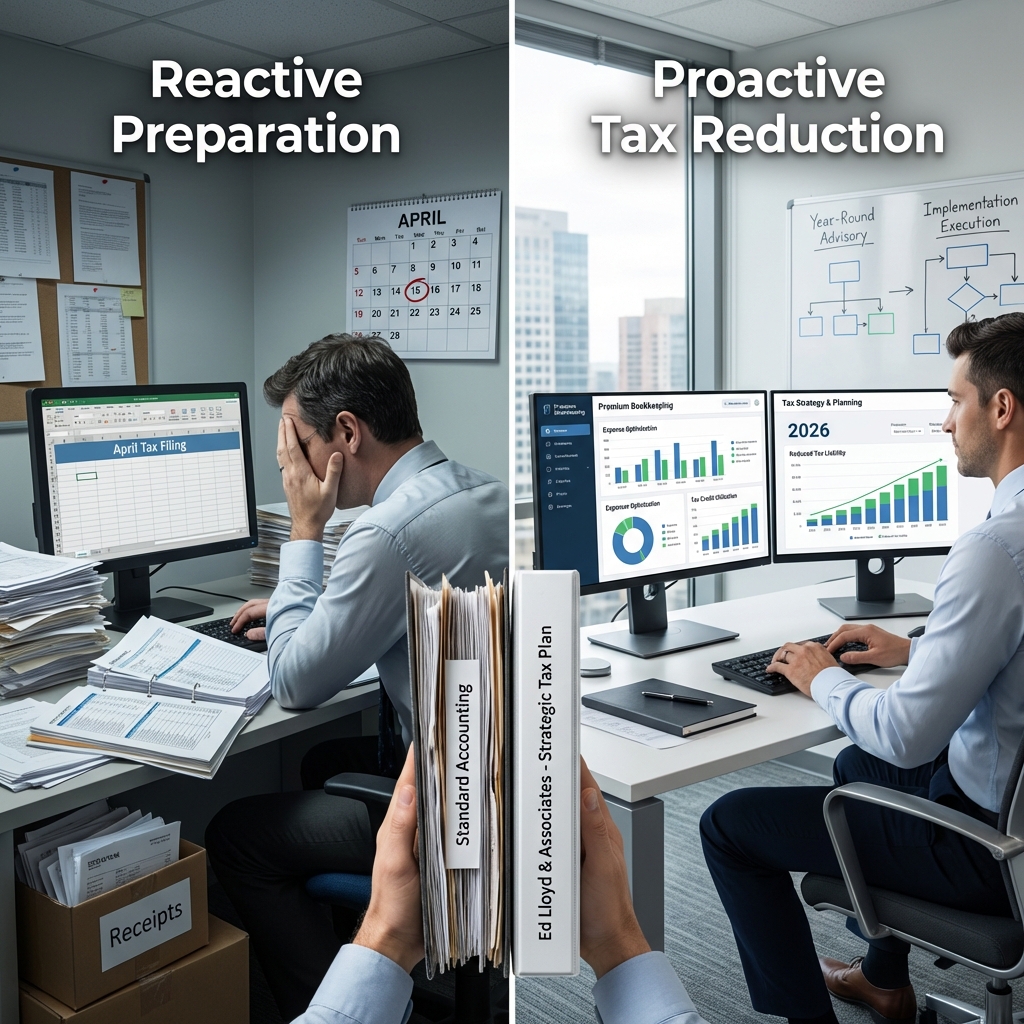
Our Year-Round Tax Advisory service eliminates the year-end surprise. You’ll have quarterly tax planning sessions with a dedicated CPA who knows your business inside-out. These sessions address:
- Performance review against projections.
- Tax impact of decisions you’re considering (adding staff, major purchases, new service lines).
- Estimated tax adjustments based on current year performance.
- Changes in tax law that affect your strategy.
You’ll also receive quarterly financial statements (P&L, balance sheet, cash flow). This isn’t just accounting—it’s insight. You’ll know exactly where your business stands financially and how it impacts your tax position.
The difference is profound. Most business owners see their full financial picture once a year. By then, it’s history. Our clients see it quarterly and can adjust course in real time.
Bookkeeping Foundation for Tax Optimization
Strategy is only as good as your underlying data. We provide dedicated bookkeeping services specifically designed to support tax optimization, not just general accounting.
Our Premium Bookkeeping service includes:
- Monthly P&L, balance sheet, and cash flow statements.
- Bank and credit card reconciliation (catches errors and fraud).
- Expense categorization aligned to tax strategy (not just by department).
- Transaction review for potential business vs. personal classification issues.
- A dedicated bookkeeper assigned to your account for continuity and insight.
This foundation matters because:
- Tax strategy relies on accurate, current financial data. Garbage in, garbage out applies to tax planning as much as anything else.
- Expense categorization directly impacts deductions. A home office expense categorized as “rent” looks different than when properly documented as a qualified deduction.
- Monthly clarity drives better business decisions. You’ll spot cash flow issues, margin problems, or revenue trends that inform both business strategy and tax planning.
Clean, strategically organized bookkeeping is the bedrock that allows us to maximize your tax reduction without increasing audit risk.
Real Results: Measurable Tax Savings for Business Owners
We regularly achieve 30-50% reductions in taxable income for service business owners through proactive structuring and optimization. For an owner with $500K in taxable income, this translates to $150K-$250K in tax savings.
These aren’t typical outcomes for standard firms. They’re possible because we combine strategy, technical depth, and execution.
Results mentioned are not typical and individual results will vary based on your specific situation. Outcomes depend on your current business structure, income sources, personal situation, and how aggressively you implement strategies we recommend. We’ll provide a specific estimate during your initial analysis.
Common savings sources for our clients:
- Entity restructuring: $15K-$45K annually.
- Retirement contribution optimization: $20K-$80K annually.
- Expense strategy and deduction identification: $10K-$30K annually.
- Tax credit utilization: $5K-$25K annually.
The cumulative impact is substantial. And it compounds year after year because the structure stays in place.
Our Educational Approach to Tax Complexity
We don’t believe tax strategy should feel like black magic. Our clients understand the strategies we implement and why. This builds confidence, ensures compliance, and creates informed decision-makers.
We pull back the curtain on complex topics like material participation rules, the 100-Hour Test, bonus depreciation, and the Buy, Borrow, Die strategy. These concepts sound intimidating. They’re actually logical once explained properly.

Our approach includes:
- Written summaries of strategies we recommend, explaining the mechanics and benefits.
- Educational sessions during quarterly meetings, focused on one concept at a time.
- Access to resources explaining recent tax law changes and how they affect your situation.
- Transparency about the trade-offs. Some strategies are aggressive and carry higher audit risk. Others are conservative. We explain both and let you decide.
A truly helpful CPA firm educates, not mystifies. You should understand your tax plan and feel confident defending it if questioned.
Why the Right CPA Relationship Matters Now
Tax law is shifting. The One Big Beautiful Bill Act of 2025 modified several provisions that directly impact service business owners. Strategy that worked in 2024 might need adjustment today.
More broadly, the IRS is increasing scrutiny of high-income service businesses. The days of passive tax filing are over. Aggressive planning without documentation and defensibility invites audit risk.
The right CPA relationship provides three things:
- Current knowledge of tax law changes and how they affect you.
- Technical depth to structure strategies that minimize audit risk.
- Partnership that treats your tax planning as part of your business strategy, not a compliance obligation.
A transactional relationship with a preparer won’t cut it. You need a strategist.
Making Your Decision: What to Look For in a Tax Partner
Evaluate any firm using these questions:
- Do they focus on planning, not just preparation? Ask specifically about their tax reduction process.
- Will you have a dedicated CPA who knows your business, or rotate through staff?
- Do they offer quarterly reviews and adjustments, or only annual tax preparation?
- Can they explain a specific strategy you should implement? (Vagueness is a red flag.)
- Do they integrate bookkeeping with tax strategy, or treat them as separate functions?
- Will they educate you on strategies, or keep you in the dark?
- What’s their fee model? Hourly billing discourages deep planning. Value-based or retainer models align better with your interests.
You’re not shopping for the cheapest option. You’re evaluating who will credibly protect and optimize your financial position year-round.
Partner With Us to Keep More of What You Earn
We’ve spent years building a practice designed to answer a single question: How much can this business owner legally keep? Then we execute the answer.
Our tax reduction services combine proactive strategy, technical execution, and ongoing partnership. We handle the complexity of tax planning and compliance so you can focus on running your business and keeping more of what you earn.
Service business owners with $2M+ in revenue and $500K+ in taxable income are our specialty. We understand your profit margins, your income volatility, and the specific tax opportunities available to your industry.
Here’s how to move forward:
- Schedule an initial consultation to discuss your situation and current tax position.
- We’ll conduct a preliminary tax reduction analysis, identifying 2-3 immediate opportunities.
- Present specific recommendations with estimated savings and implementation details.
- You’ll decide if our approach and partnership model align with your needs.
We’re confident in the process because it works. But results depend on your specific situation, your willingness to implement strategies, and your business performance.
This information is for educational purposes only and does not constitute tax, legal, or financial advice. Always consult with a qualified tax professional before implementing any tax strategy.
Let’s start the conversation. Reach out today to explore how much you can actually keep.
Ready to Cut Your Taxes – Schedule a game plan review and see how much you can save – https://join.elcpa.com/vsl-2

Recent Comments