

The Hidden Cost of Manual Bookkeeping and Tax Prep
You’re spending 10+ hours a month on spreadsheets, receipts, and invoice tracking. Your accountant files your return in April based on data you scrambled to organize. By then, it’s too late. The tax bill arrives, and you realize you’ve overpaid by tens of thousands.
This isn’t incompetence. It’s a system problem.
Manual bookkeeping creates a critical gap: your financial data sits in silos until tax time, disconnected from strategy. Bank feeds go unmapped. Expense categories blur together. Invoices pile up. When your accountant finally sees the full picture, they’re doing damage control, not tax planning.
We’ve watched service business owners leave 30-50% of potential tax savings on the table simply because their bookkeeping wasn’t feeding real-time insights into their tax position. The cost isn’t just the wasted hours. It’s the forgotten deductions, the timing mistakes, and the reactive stance that costs you actual dollars.
Automation breaks this cycle. When bookkeeping flows automatically into your accounting system, you and your team gain visibility month-to-month. Better visibility drives better decisions.
What to do next: Audit your current bookkeeping process. How much time does manual data entry consume? How long after month-end before you know your actual profit?
Why Service Business Owners Struggle With Financial Management
Service-based businesses operate differently than product companies. You don’t have inventory to track. You have billable hours, project margins, and variable labor costs that shift with client demand and staffing changes.
Most off-the-shelf accounting software assumes you fit a standard mold. You don’t.
Your revenue is predictable one month and scattered the next. Client payments don’t always match invoice dates. Contractor expenses, equipment purchases, and professional development blur the line between business and personal spending. Your profit margin depends on real-time labor allocation, which traditional bookkeeping never captures.
Then there’s the time trap. You’re selling hours or delivering projects, not managing spreadsheets. Every minute spent reconciling transactions is a minute not spent on client delivery or business development. That’s not just inefficiency, it’s opportunity cost.
Add to this the complexity of deductions available to you: home office calculations, vehicle expenses, professional licenses, continuing education, software subscriptions, health insurance premiums. Most service owners capture 40-60% of what they’re actually entitled to claim.
What to do next: List the three biggest accounting pain points in your business right now. Which one directly impacts your profitability or wastes the most time?
How Automation Transforms Your Tax Position
Automation rewires the relationship between daily operations and tax strategy. Instead of a once-a-year scramble, you’re continuously monitoring your tax exposure and opportunity.
Here’s what changes:
Real-time visibility. You see your profit, tax liability, and effective tax rate updated monthly, not April. This means you can adjust spending, timing, and strategy while the year is still in play.

Categorized data as it happens. Expenses are tagged automatically as they hit your bank account. Your accountant doesn’t guess whether that software license qualifies as a deduction or a capital asset. It’s already categorized correctly.
Continuous alignment. Your bookkeeping system talks to your tax planning framework. We notice when you’re trending toward overpayment or when a new strategy could apply.
Defensible records. Automated systems create audit trails. Every transaction is timestamped, categorized, and documented. The IRS prefers consistent, documented processes over guesswork.
When your bookkeeping automation feeds into our proactive tax strategy, the effect compounds. You’re not managing historical data. You’re actively steering your tax position toward the outcome you want.
What to do next: Identify which of your expense categories you’re least confident about. Those are your biggest leakage points.
Our Proactive Automation Framework for Service Businesses
We don’t believe in generic solutions. Our automation framework is built specifically for how service businesses operate.
Step 1: Foundation Setup. We integrate your bank accounts, credit cards, and payment processors into a unified accounting platform. Transactions flow in automatically, categorized against a chart of accounts we customize for your business model.
Step 2: Expense Intelligence. We tag recurring expenses, flag unusual transactions, and set up rules that learn your spending patterns. Over time, the system catches categorization errors before they become tax problems.
Step 3: Revenue Mapping. For service businesses, we ensure client billing ties directly to revenue recognition. We track billable hours, project profitability, and any deferred revenue so your P&L reflects reality, not just cash collected.
Step 4: Tax Integration. We layer our tax strategy framework over your automated bookkeeping. This means quarterly reviews of your tax position and proactive adjustments to deductions, timing, and structure before year-end.
Step 5: Performance Dashboards. You get real-time visibility into profit margin by client, labor efficiency, and cash flow trends. This informs both tax decisions and business strategy.
The goal is simple: eliminate manual data entry and continuous reconciliation so you can focus on running your business while we focus on keeping more of what you earn.
What to do next: Audit your current software stack. How many platforms are you managing? Consolidation alone saves time and reduces categorization errors.
Integrating Bookkeeping Data Into Strategic Tax Planning
This is where automation delivers its real power.
Most accountants work backward. They look at your year-end numbers and file your return. We work forward. We use your automated bookkeeping data to model tax scenarios and adjust strategy throughout the year.
In March, if we see you tracking toward $500K in taxable income, we evaluate whether timing a major purchase, adjusting your business structure, or leveraging a specific deduction makes sense for your situation. But we can only do this if your bookkeeping data is current, organized, and integrated into our planning process.
Automation makes this possible. Your software syncs with ours. We see profit-and-loss trends in real time. We model the tax impact of potential decisions and recommend next steps while there’s still time to act.
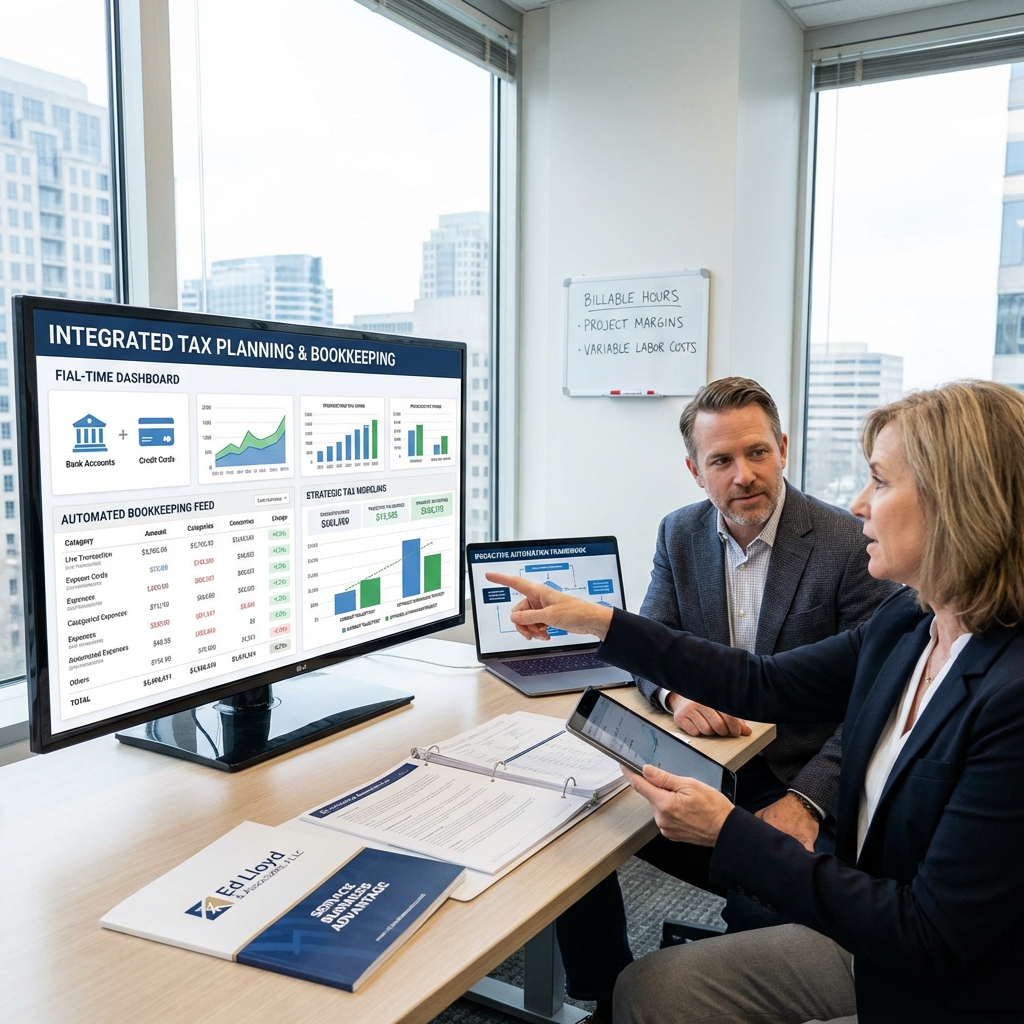
For service business owners, this often means identifying whether your current business structure (sole proprietor, S-Corp, C-Corp, LLC) is still optimal given your income level and profit margins. It means evaluating passive loss strategies, home office deductions calculated correctly, and vehicle expense allocation based on actual usage.
Results mentioned are not typical and individual results will vary based on your specific situation. Always consult with a qualified tax professional before implementing any tax strategy.
What to do next: Schedule a quarterly tax review. Don’t wait until December to discuss your tax position.
The Real ROI of Automating Your Financial Operations
Service business owners ask us this directly: “What’s the return on investing in automation?”
The answer breaks into two buckets: time savings and tax savings.
Time savings: Manual bookkeeping typically costs service business owners 8-12 hours per month. At your billing rate, that’s $2,000-$5,000 in lost opportunity cost. Automated bookkeeping with basic oversight cuts this to 1-2 hours monthly. That’s $15,000-$50,000 in reclaimed time per year.
Tax savings: This varies by situation, but service business owners typically discover $10,000-$50,000 in missed deductions once their bookkeeping is organized and feeding into proactive tax planning. When we integrate automation with strategic tax advisory, we’ve helped clients reduce their effective tax rate by 15-30 percentage points.
Both matter. But the tax piece is where most owners underestimate the opportunity. When your data is automated and visible, we can actually identify these opportunities before they’re lost.
What to do next: Calculate your effective tax rate from last year. If it’s above 35-40%, there’s likely room for improvement.
Common Automation Mistakes That Cost You Thousands
We see patterns. And we see mistakes that undo the benefits automation promises.
Mistake 1: Automation without proper categorization. You set up bank feeds but never configure your chart of accounts. Transactions auto-categorize incorrectly, and nobody catches it. Your reports are garbage, so you don’t trust them and revert to manual tracking.
Fix this: Invest time upfront in chart-of-accounts design. Your accountant or bookkeeper should own this before a single transaction imports.
Mistake 2: Automating without strategy alignment. You implement accounting software because it’s cheaper than hiring a bookkeeper. But it’s not integrated with any tax plan. You end up with organized data that doesn’t inform better decisions.
Fix this: Automation is a tool, not a strategy. Pair it with quarterly tax reviews and real-time planning.
Mistake 3: Ignoring the audit trail. You automate most transactions but continue to handle cash, tips, or small purchases informally. The IRS doesn’t like gaps in documentation, even if everything else is clean.
Fix this: Document everything. Even small expenses need a receipt and category.
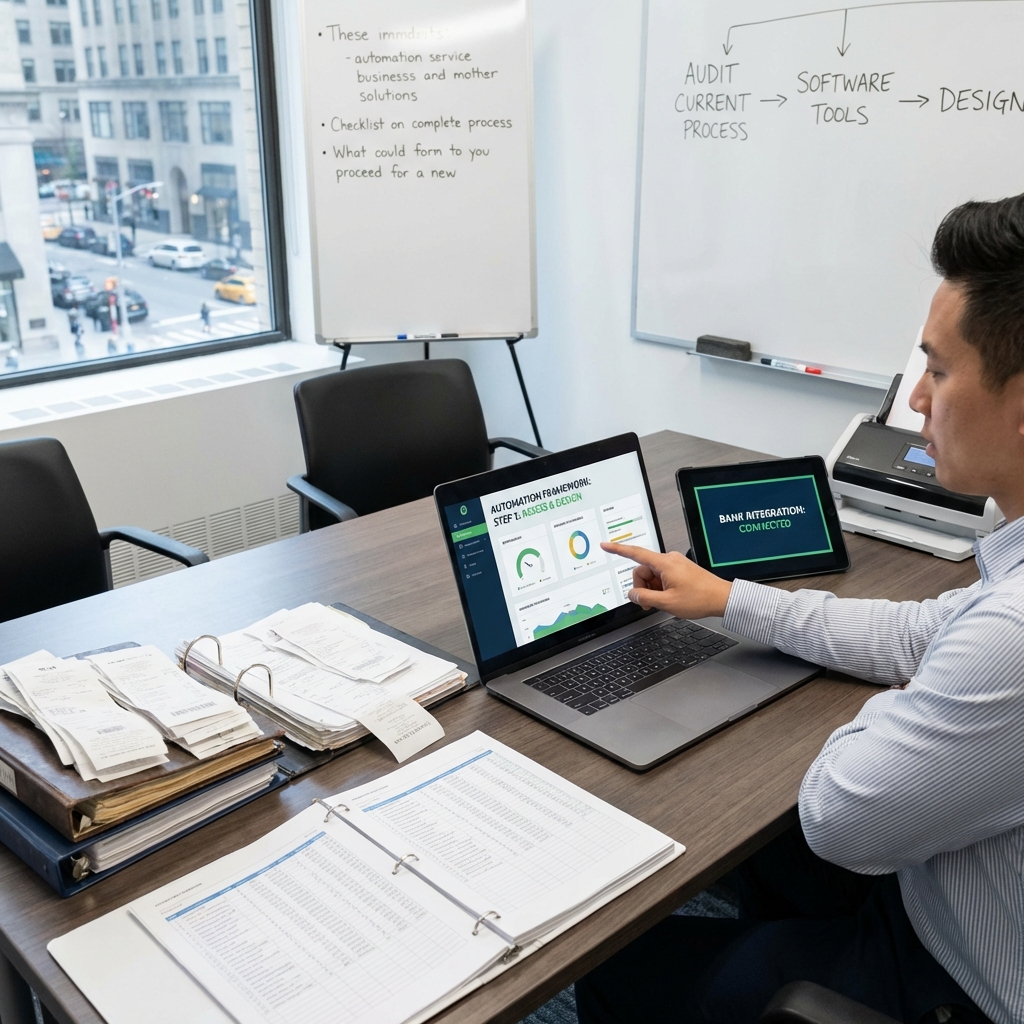
Mistake 4: Setting and forgetting. You implement automation and assume it will self-correct. Categorization rules drift. Misclassifications compound. By year-end, your bookkeeper is untangling mess instead of preparing strategy.
Fix this: Review your automation monthly. Spot trends and errors early.
What to do next: If you’ve already automated, pull a sample month and verify categorization accuracy across 20 random transactions.
How We Help You Keep More of What You Earn
We combine automation with active tax strategy. That’s our core offering.
We set up or optimize your bookkeeping automation so data flows cleanly into your accounting system. We then layer on quarterly reviews where we analyze your position, model tax scenarios, and recommend specific actions while there’s time to implement them.
For service business owners with $2M+ in revenue and $500K+ in taxable income, this approach typically unlocks 30-50% tax reductions through legitimate, defensible strategies. We’re not talking about grey-area deductions. We’re talking about the structured use of business deductions, timing strategies, and occasionally business structure optimization that most accountants never explore because they’re too busy filing returns.
Our CPA tax reduction services focus specifically on your situation as a service business owner. We understand your revenue patterns, your deduction opportunities, and the strategies that actually work for your business type.
This information is for educational purposes only and does not constitute tax, legal, or financial advice. Always consult with a qualified tax professional before implementing any tax strategy.
What to do next: Schedule a tax position review. We’ll analyze your last two years of returns and identify specific opportunities in your situation.
Getting Started With Your Automation Strategy
If you’re ready to pull back the curtain on your bookkeeping and tax position, start here.
Month 1: Assess and Design. Audit your current bookkeeping process. What software are you using? What’s working? What’s costing you time or accuracy? We’ll help you design a system that fits your business model and integrates with proactive tax planning.
Month 2: Implement Core Automation. Connect your bank accounts and payment processors. Set up your chart of accounts correctly. Import historical data if needed. Test the system with a few weeks of transactions before full rollout.
Month 3: Validate and Refine. Run a full month of automated transactions. Review categorization. Adjust rules. Train anyone on your team who needs to interact with the system. Ensure data flows to your tax advisor.
Ongoing: Quarterly Reviews. Meet with us every quarter to review your tax position, analyze trends, and adjust strategy. This is where automation delivers its real value.
Service business owners who automate their bookkeeping gain two superpowers: time back to grow your business and the visibility to make smarter tax decisions. Both matter. Together, they’re transformative.
We’re here to help you get there. Reach out if you’re ready to explore how this works for your specific situation.
Ready to Cut Your Taxes – Schedule a game plan review and see how much you can save – https://join.elcpa.com/vsl-2

Recent Comments