

Table of Contents
- The Real Cost of Overpaying Taxes as a Service Business Owner
- Why Traditional Tax Preparation Leaves Money on the Table
- The 50% Tax Reduction Framework We Use for Our Clients
- Entity Structuring and Expense Optimization Strategies
- Advanced Tax Credits and Deductions You're Likely Missing
- Year-Round Tax Planning vs. Reactive Year-End Preparation
- How We Implement Proactive Tax Strategies While Maintaining IRS Compliance
- Quarterly Reviews and Adjustments Keep Your Strategy on Track
- Real Results: What Our Service Business Owner Clients Achieve
- Getting Started with Your Personalized Tax Reduction Plan
The Real Cost of Overpaying Taxes as a Service Business Owner
You’re running a successful service business. Revenue is strong. Profit margins look solid. Then tax season hits, and you watch thousands or hundreds of thousands vanish to federal and state income taxes. That stinging feeling isn’t just frustration—it’s a sign you’re likely overpaying by a massive margin.
We’ve spent years helping service business owners like you recover what the tax code actually allows. The gap between what you’re paying now and what you should be paying isn’t a loophole or gray area. It’s systematic neglect. Most business owners rely on traditional tax preparation, which is reactive and incomplete. We operate differently: we build your tax reduction strategy year-round, starting months before any return gets filed.
Here’s what we’ve learned: the businesses that cut their taxes by 50% or more don’t do anything illegal. They do the exact opposite of what most owners do. They plan ahead. They structure properly. They claim every legitimate deduction. And they monitor quarterly.
Let’s pull back the curtain on how this actually works.
You’re not just losing money to taxes. You’re losing the compound growth that money could have generated for your business. A $100,000 tax overpayment this year is $150,000 in lost value five years from now (assuming reasonable growth assumptions).
We see this pattern repeatedly: service business owners with $2M+ in revenue and $500K+ in taxable income routinely pay 40-50% of their income in combined federal, state, and self-employment taxes. Not because they made mistakes. Because nobody systematically addressed the tax code’s legitimate strategies designed for exactly their situation.
Consider this: you earn $500K in taxable income and pay 45% in total taxes. That’s $225,000 gone. If we reduce your effective rate to 25% through proper structuring and strategy, you keep an additional $100,000 annually. Over ten years, that’s over $1 million in recovered capital—before any investment growth.
What to do next: Calculate your true tax rate. Divide your total tax liability (federal, state, self-employment, everything) by your net business income. If it exceeds 30%, you likely have significant recovery opportunity.
Why Traditional Tax Preparation Leaves Money on the Table
Most tax preparers work backward. They wait until December or January, gather receipts and documents, run numbers through software, and file a return. This reactive approach means 90% of tax-saving strategies are already off the table by the time they start working.
Traditional preparation also treats all service businesses the same. A consulting firm, an engineering practice, a medical professional, a law practice, a real estate services business—they all get similar treatment. But the tax code offers different opportunities for each. Miss those nuances, and you miss five or six figures.
Here’s the problem with year-end tax prep: the best deductions aren’t accidental. They require structure. They require documentation. They require planning. A January conversation about “what you could have done” is too late. The year already happened.
We approach this completely differently. We treat tax preparation as the final reporting step, not the planning event. By the time you file, the strategic work is finished.
Your action item: Ask your current tax preparer three questions. First, when did they start planning for your 2026 taxes? If the answer is December or later, that’s a red flag. Second, what specific tax reduction strategies did they model for your business structure? Third, what’s your effective tax rate compared to similar businesses in your industry? If they can’t answer these with specifics, you’re likely in the reactive camp.
The 50% Tax Reduction Framework We Use for Our Clients
We don’t promise 50% reductions to everyone. Results depend entirely on your situation. But we consistently see significant recoveries because we follow a systematic framework across four pillars.

First: Entity Structure and Legal Optimization. The business entity you chose (S-corp, LLC, C-corp, sole proprietor) is either working for you or against you. We evaluate whether your current structure is actually optimizing self-employment taxes, income splitting, and liability protection. Sometimes the fix is structural; sometimes it’s about election choices within your existing entity.
Second: Legitimate Deductions and Expense Optimization. Service businesses have blind spots. Home office deductions, vehicle expenses, equipment depreciation, contractor relationships, and retirement plan strategies are routinely missed or underutilized. We conduct a detailed expense audit to identify what you’re claiming versus what the IRS allows.
Third: Advanced Credits and Loss Strategies. This isn’t just standard deductions. We look for R&D credits, qualified business income (QBI) deductions, cost segregation, and strategies to convert passive losses to active losses where material participation applies.
Fourth: Cash Flow Alignment and Monitoring. Taxes should enhance cash flow, not destroy it. We structure payments, withdrawals, and timing so you’re not hit with a massive bill on April 15th while starving operational cash.
Entity Structuring and Expense Optimization Strategies
Your business entity is either a tax liability or a tax asset. Most service business owners never reconsider the choice they made years ago.
If you’re currently operating as a sole proprietor or a single-member LLC filing as a sole proprietor, you’re paying self-employment taxes on 92.35% of your net income. That’s roughly 15.3% on top of your regular income tax. For a $500K business, that’s approximately $70,000 in additional tax burden you don’t need.
An S-corp election, properly structured, can reduce this significantly. By taking a reasonable salary and distributing the rest as dividends, you only pay self-employment tax on the salary portion. The distribution avoids the 15.3% self-employment tax. For appropriate situations, this saves $15,000-$40,000+ annually. This information is for educational purposes only and does not constitute tax, legal, or financial advice. Always consult with a qualified tax professional before implementing any tax strategy.
On the expense side, we work with you to identify categories you’re either neglecting or underutilizing.
Common optimization areas for service businesses:
- Depreciation schedules (often not claimed aggressively enough)
- Vehicle and equipment deductions (tied to material participation and business use)
- Home office deductions (whether you work from home or maintain a dedicated office)
- Retirement plan contributions (SEP-IRA, Solo 401k, defined benefit plans scaled to business size)
- Professional development and continuing education expenses
- Contractor versus employee classifications (critical distinction for tax treatment)
- Business use of personal property conversions
Here’s what you need to do: Pull your last three tax returns. For each deduction category, ask: am I claiming the maximum legally available? Most owners answer no to at least three categories. Those gaps are your recovery targets.
Advanced Tax Credits and Deductions You’re Likely Missing
Beyond standard expense deductions, the tax code contains credits and strategies that service businesses simply don’t know about.
Research and Development (R&D) Credit: If you develop new methods, processes, or solutions in your service business, you may qualify for the federal R&D credit. This isn’t just for tech companies. Engineering practices, consulting firms, and specialized service providers often qualify. The credit is substantial: up to 20% of qualifying expenses. Most service businesses we meet have never explored it.
Qualified Business Income Deduction (QBI): Pass-through businesses can deduct up to 20% of qualified business income. There are limits based on taxable income, but for service business owners in strong positions, this is a significant deduction. The strategy lies in maximizing which income qualifies and minimizing which doesn’t.
Cost Segregation: If you’ve invested in equipment, software, leasehold improvements, or furnishings, cost segregation might be available. This is a detailed engineering analysis that can accelerate depreciation. Over 5-7 years, it generates significant deductions today rather than spreading them across decades.
Converting Passive to Active Losses: If you have passive investment losses outside your primary business, you might unlock them through the “material participation” test or the “100-Hour Test.” Active losses can offset business income dollar-for-dollar, while passive losses face limitations.
What to do immediately: Work with us to conduct a credit and deduction audit. We’ll identify which of these strategies apply to your business. Some require filing amended returns to recapture prior-year benefits.
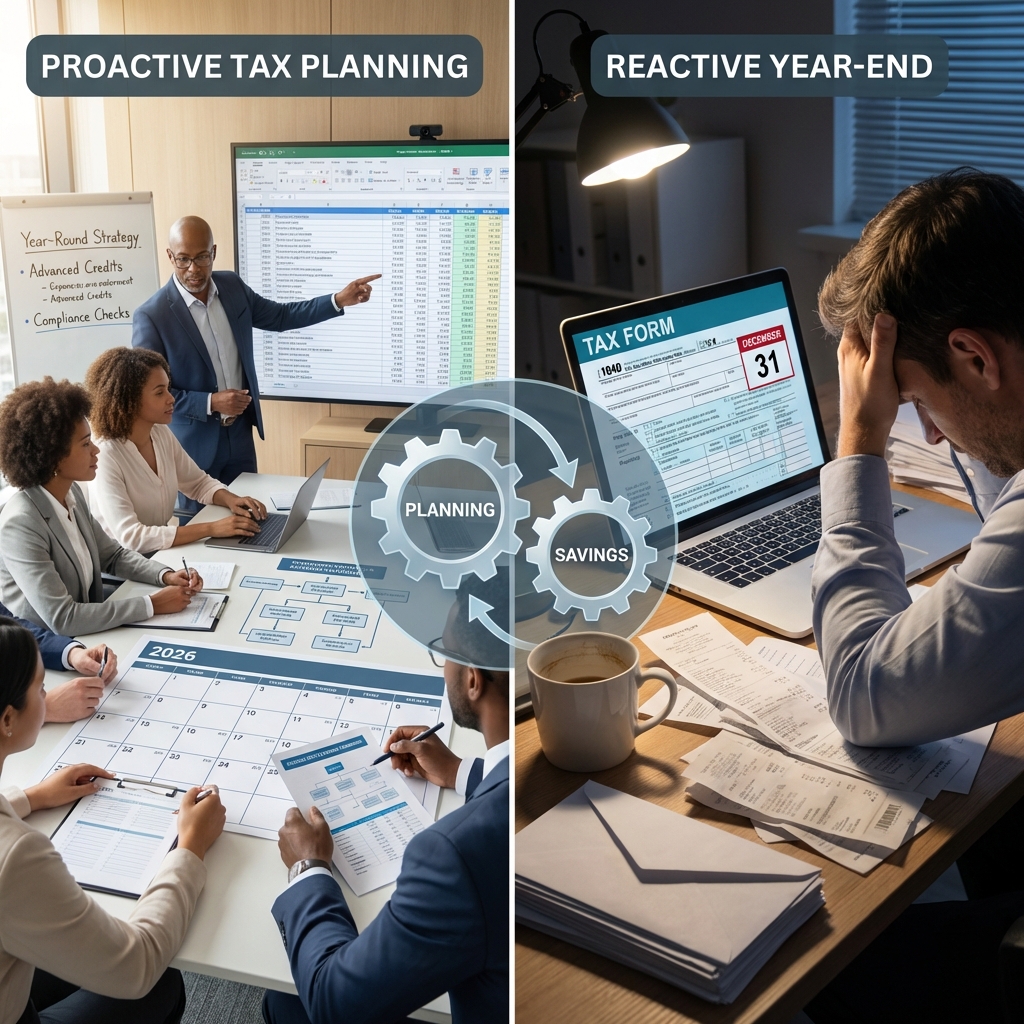
Year-Round Tax Planning vs. Reactive Year-End Preparation
The difference between a $50,000 tax bill and a $100,000 bill often comes down to timing: when you made decisions and when you acted on them.
Year-round tax planning means we’re evaluating decisions you’re about to make—before you make them. Should you hire a new contractor or convert to employees? We model the tax impact. Do you have excess cash that could be sheltered? We explore it. Is your quarterly estimated payment optimal, or are you overpaying? We adjust it.
Reactive year-end preparation means December 31st rolls around, you call your accountant, and both of you scramble to find deductions that are already locked in by your operating decisions.
With year-round planning, we’re inside your business. We see the revenue pattern, the expense patterns, and the structural challenges. We adjust quarterly. We file amended returns if we spot optimization we missed. We model alternative scenarios so you can make informed business decisions with full tax awareness.
Your next move: Establish a quarterly tax review rhythm. Rather than an annual conversation after the fact, schedule four touchpoints. We review actual results, adjust projections, and identify mid-course corrections. Most businesses pay for this in saved taxes within the first quarter.
How We Implement Proactive Tax Strategies While Maintaining IRS Compliance
Let’s be direct: aggressive tax planning and IRS compliance aren’t opposites. They’re partners. The most defensible tax positions are the ones grounded in clear statute and regulation.
We pull back the curtain on our process. Every strategy we recommend starts with statute. Not gray area. Not interpretation. Direct language in the Internal Revenue Code or IRS guidance. We document the position. We maintain contemporaneous records. We prepare the return in a way that clearly demonstrates the strategy.
When the 100-Hour Test applies to material participation, we track hours. When we claim cost segregation, we obtain a qualified engineer’s report. When we structure an S-corp, we document reasonable salary payments. When we claim the home office deduction, we photograph and measure the dedicated space.
This approach protects you. It also protects us. And it means if an IRS agent ever questions your return, we have documentation, not excuses.
Results mentioned are not typical and individual results will vary based on your specific situation. Always consult with a qualified tax professional before implementing any tax strategy.
Many service business owners believe “aggressive tax planning” means hiding income or inflating deductions. That’s not strategy; that’s fraud. Real strategy exploits legal structures and timing the code explicitly allows. S-corp elections. Depreciation schedules. Retirement contributions. Credits explicitly written into statute. These aren’t loopholes. They’re features.
Quarterly Reviews and Adjustments Keep Your Strategy on Track
A tax strategy built in January doesn’t survive reality in July. Business changes. Revenue exceeds expectations. Expenses shift. Ownership changes. New contracts flow in.
Quarterly reviews aren’t optional. They’re the operating system of proactive tax management.
During each quarterly review, we examine:
- Year-to-date income compared to projections
- Expense categories and timing adjustments
- Estimated quarterly tax payment accuracy
- Cash flow impact of projected year-end numbers
- Changes to business structure or operations
- New tax law developments affecting your situation
- Opportunity identification (new deductions, credits, or restructuring possibilities)
Most service businesses skip this discipline. Then December arrives, the numbers come in, and they’re shocked by the tax bill or amazed they refunded $40,000. Neither outcome is acceptable.

With quarterly reviews, you know where you stand. You adjust proactively. You make strategic decisions with clear tax understanding.
Do this today: Block your calendar for quarterly tax reviews. March 31st. June 30th. September 30th. December 15th. These four meetings represent the difference between recovering $50,000 and recovering $150,000 across the year.
Real Results: What Our Service Business Owner Clients Achieve
Our clients keep more of what they earn. That’s not a tagline; it’s the outcome we measure against.
A consulting practice owner with $2.8M in revenue was operating as an LLC, paying roughly $85,000 in self-employment taxes annually. After S-corp election and salary optimization, we reduced that to $12,000. The structure, proper documentation, and quarterly monitoring protected the position. Result: $73,000 in annual savings.
An engineering services firm with $1.9M in revenue had never claimed the R&D credit despite significant project development activity. Through a multi-year analysis, we identified $850,000 in qualifying expenses. The credit generated $170,000 in federal refunds spread across amended returns.
A medical practice operating from a home office had never claimed a deduction despite maintaining a dedicated clinical space. Combined with optimized vehicle deductions and improved contractor classification strategy, we created $31,000 in additional deductions that cascaded to $9,300 in annual tax savings.
These results required work. They required documentation. They required willingness to do things differently. But they happened because we applied systematic strategy rather than reactive preparation.
Results mentioned are not typical and individual results will vary based on your specific situation.
Getting Started with Your Personalized Tax Reduction Plan
The first step isn’t filing an amended return or restructuring your entity. It’s clarity.
We begin with a Tax Reduction Roadmap: a detailed analysis of your current situation, immediate opportunities, and longer-term strategies ranked by impact and implementation complexity.
The roadmap covers:
- Your current effective tax rate and comparison to your industry
- Quick wins you can implement this year
- Structural changes with multi-year benefit potential
- Documentation and compliance requirements
- Quarterly monitoring framework
You’ll leave knowing exactly what’s possible, what we recommend, and what the implementation timeline looks like. No surprises. No vague promises.
We work exclusively with service-based business owners who have $2M or more in revenue and $500K+ in taxable income. This focus means we understand your specific challenges, your growth stage, and the strategies that actually move the needle.
Ready to unlock the playbook? Schedule a Tax Reduction Strategy call with us. We’ll spend 45 minutes understanding your business, identifying your top opportunities, and showing you exactly how to keep more of what you earn.
This information is for educational purposes only and does not constitute tax, legal, or financial advice. Always consult with a qualified tax professional before implementing any tax strategy.
Ready to Cut Your Taxes – Schedule a game plan review and see how much you can save – https://join.elcpa.com/vsl-2

Recent Comments