

Table of Contents
- Why Most Service Business Owners Leave Money on the Table
- The Hidden Cost of Generic Accounting Solutions
- How We Pull Back the Curtain on Tax Inefficiency
- Our Proactive Tax Reduction Strategy for Service Businesses
- Year-Round Tax Planning That Eliminates Year-End Surprises
- Premium Bookkeeping as Your Financial Foundation
- From Numbers to Actionable Business Insights
- Why Accuracy Matters in Tax Preparation and Compliance
- How We Partner With You Beyond Tax Season
- Taking Control of Your Financial Future
- Frequently Asked Questions (FAQ)
Why Most Service Business Owners Leave Money on the Table
Here’s the uncomfortable truth: service-based business owners typically overpay federal income taxes by 50% or more. Not because of careless mistakes, but because they treat tax planning like a year-end chore instead of a strategic advantage.
Most owners focus entirely on revenue growth. They hire salespeople, invest in marketing, and scale operations aggressively. But few stop to ask a simple question: “What percentage of my profit actually stays with me?” When that number is lower than it should be, the culprit isn’t always poor business performance. It’s poor tax strategy.
We’ve worked with hundreds of high-income service professionals—consultants, contractors, service providers earning $2M+ in revenue with $500K+ in taxable income. Nearly all of them arrive at our office with the same frustration: they’re writing enormous tax checks while watching competitors keep more of what they earn. The gap isn’t talent. It’s strategy.
The cost of inaction compounds. Every dollar overpaid in taxes is a dollar you can’t reinvest in growth, take home as profit, or allocate toward retirement. Over a decade, that inefficiency costs six figures or more.
What to do next: If your last tax bill felt punitive, schedule a tax assessment with a qualified CPA who specializes in high-income service businesses. Don’t assume you’re already optimized.
The Hidden Cost of Generic Accounting Solutions
Generic accounting solutions fail service business owners for one reason: they’re built for average situations, not exceptional ones. A solo consultant earning $1.5M in revenue operates under completely different rules than a packaged service business doing the same revenue with four employees.
Many business owners use cloud-based bookkeeping tools (or hire an entry-level bookkeeper) to handle basic transaction entry and monthly reconciliations. These setups work fine for compliance and basic reporting. But they miss the real opportunity: identifying and executing tax reduction strategies embedded in your business structure.
A generic CPA filing your 1040-S or C-Corp return at tax time won’t see what we see. They won’t analyze your entity structure, review your pass-through losses, or evaluate whether you’re positioned to turn passive losses into active losses. They process what exists instead of reimagining what’s possible.
Cost matters too. If you’re paying $1,500 for a tax return that could have been optimized to save you $50,000, your “cheap” solution actually costs you $48,500. Most owners don’t measure it that way, so the bad deal feels invisible.
The hidden expense is opportunity cost: months of overpayment, missed deductions, and untapped strategies because your accounting provider isn’t equipped to look beyond quarterly filings.
Action item: Compare your current CPA’s scope. Do they proactively discuss tax reduction strategies, or do they only react to what you show them? The difference determines your bottom line.
How We Pull Back the Curtain on Tax Inefficiency
We approach every client engagement with one goal: reveal the gap between what you’re paying and what you legally owe. This requires pulling back the curtain on how your business structure, income timing, and entity type interact with the tax code.
Most service business owners don’t fully understand their own tax exposure. They see a net income number and assume that’s taxable income. It rarely is. Deductions, credits, and strategic positioning create layers of opportunity that generic providers never discuss.
Our process starts with a comprehensive tax analysis. We review your prior returns, your business structure, your asset allocation, and your income composition. We ask hard questions: Are you in the right entity type? Is material participation properly documented? Can your business structure support legitimate pass-through losses? Are there time-sensitive strategies we should deploy this year?
This analysis isn’t theoretical. It results in concrete adjustments: a new entity structure, a retirement plan repositioning, a cost-segregation study, or a strategic timing shift in income or deduction recognition.
We then translate those findings into an actionable tax reduction roadmap specific to your situation. Not a generic list of “maybe” deductions, but a prioritized plan with projected impact and implementation steps.
Your move: Request a detailed tax review from your current provider. If they can’t articulate specific tax reduction opportunities tied to your situation, that’s a red flag worth acting on now.
Our Proactive Tax Reduction Strategy for Service Businesses
We don’t wait until December 31st to think about taxes. Proactive tax reduction is a year-round discipline built into how we serve you.
Here’s how we structure this engagement:
Quarterly reviews. We analyze your income, deductions, and estimated tax liability every 90 days. This allows us to adjust strategy mid-year, not after the fact. If a major contract closes or a business purchase changes your structure, we recalibrate immediately.
Entity optimization. For high-income service owners, entity structure is foundational. We evaluate S-Corp vs. C-Corp vs. Partnership vs. sole proprietor positioning and recommend the structure that minimizes your combined federal, state, and self-employment tax burden. Results mentioned are not typical and individual results will vary based on your specific situation.
Deduction sequencing. Timing deductions strategically can mean the difference between claiming them and losing them. We identify which deductions benefit from acceleration versus deferral, then execute accordingly.
Loss positioning. If your business generates losses or passive activities, we analyze whether those can offset other income under active participation rules. This is where the real tax savings happen for high-income service owners.
Retirement plan strategy. A properly designed Solo 401(k), SEP-IRA, or defined-benefit plan doesn’t just shelter retirement income—it’s a legitimate tax reduction tool. We size these to your situation.
Our tax reduction services aren’t generic. They’re built on your specific income, expenses, assets, and goals. The result: clients keep more of what they earn instead of funding government inefficiency.
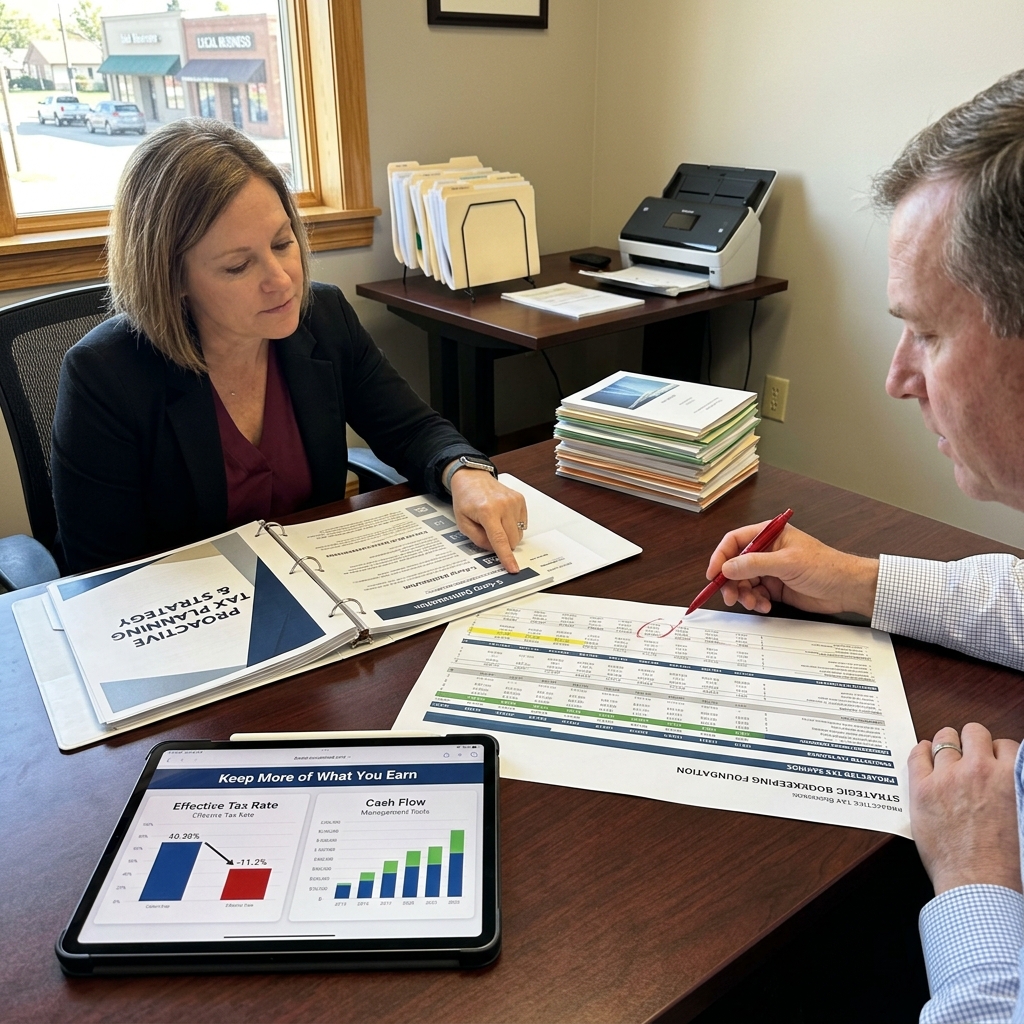
Take action: Identify one high-impact area from above (entity structure, retirement planning, loss positioning) that your current setup doesn’t address. That’s your starting point.
Year-Round Tax Planning That Eliminates Year-End Surprises
Nothing kills a profitable year like a surprise tax bill in April. Yet this happens constantly to service business owners who don’t engage in genuine tax planning.
We flip this dynamic entirely. Tax planning isn’t something we do in November; it’s embedded in how we manage your finances all year. You get visibility into your projected tax liability quarterly, not as a shock when the return lands.
Here’s what year-round planning prevents:
Estimated tax underpayment. Service business owners often underpay quarterly estimates because they don’t have real-time profit data. We provide updated projections based on actual results, so you remit the right amount without overpaying or underpaying.
Missed deduction windows. Some deductions have time-sensitive deadlines (vehicle purchases for bonus depreciation, retirement plan contributions, business acquisitions). Year-round planning ensures you don’t miss these opportunities.
Structural misfits. If your business structure no longer matches your operating reality, addressing it mid-year is cheaper than fixing it after tax season. Regular reviews catch these misalignments early.
Cash flow surprises. By projecting tax liability monthly, you avoid the cash crunch that derails owners who didn’t budget for a large tax bill. We recommend reserve amounts based on realistic projections.
The net effect: you sleep better, your accountant doesn’t scramble in April, and you capture every available tax reduction opportunity. No last-minute scrambling. No surprises.
Next step: Ask your current provider for a tax projection through year-end. If they can’t generate one, that’s a signal you need better year-round planning.
Premium Bookkeeping as Your Financial Foundation
Garbage in, garbage out. No tax strategy works if your underlying books are sloppy. Premium bookkeeping isn’t a luxury; it’s the foundation that unlocks everything else.
We handle comprehensive bookkeeping and accounting services that go beyond transaction entry. Our team categorizes expenses with precision, reconciles accounts properly, and structures your chart of accounts to align with tax reduction objectives.
This matters because clean books create several advantages:
Speed. We don’t spend weeks hunting for missing receipts or categorization errors. We can move straight to strategy.
Accuracy. Proper expense classification directly impacts your tax liability. A vehicle purchase might be depreciation, bonus depreciation, or a direct deduction depending on timing and structure. We get this right.
Visibility. Real-time bookkeeping gives you monthly P&Ls and balance sheet reports you can actually trust. You see where money comes from and where it goes.
Audit confidence. Clean records defend you in an audit. Every transaction is documented, properly categorized, and supportable. That confidence is worth something.
Tax preparation efficiency. When your accountant receives organized books, the tax return preparation is faster and cheaper. It also leaves room for strategic planning instead of firefighting.
We invest time in your bookkeeping because it’s the plumbing behind every tax recommendation we make. Poor bookkeeping ruins even the best strategy.
Action: Review your current bookkeeping quality. Are monthly reports ready by the 10th? Do category codes make sense? If answers are no, that’s costing you money and strategy opportunity.
From Numbers to Actionable Business Insights
Numbers without interpretation are just noise. We translate your financial data into strategic insights that drive better business decisions.
Every month, we analyze your performance metrics: gross margin by service line, client profitability, overhead ratios, cash conversion cycles. We identify trends—what’s working and what’s dragging—and surface opportunities for operational improvement.
These insights often reveal tax implications. If one service line consistently underperforms, the deductions supporting it become harder to defend. If cash flow lags behind revenue growth, you might need different entity positioning. If overhead is climbing, we help prioritize where to cut or where to reinvest.
This connects financial reporting to business strategy. You’re not just filing taxes; you’re using financial data to run a better business. And a better-run business naturally generates fewer tax inefficiencies.
We also use performance data to stress-test tax strategies. A retirement plan contribution looks different if your profit is flat versus growing 30% year-over-year. A bonus depreciation strategy adjusts if capital expenditures are trending down. Real numbers inform real strategy.
Do this now: Request a performance analysis from your current provider. Look at margins by service line, overhead ratios, and cash conversion. If they’re not generating these insights, you’re operating blind.
Why Accuracy Matters in Tax Preparation and Compliance
A tax return filled with aggressive positions feels bold until an auditor questions it. Accuracy and defensibility matter more than optimization.
We prepare tax returns that balance legitimate tax reduction with ironclad documentation. Every position we take is supportable; every deduction is real; every entity election aligns with your actual business structure.

This is why we’re meticulous during tax preparation:
Review for consistency. Do your current-year positions align with prior years? Are there positions that trigger flags? We think like an auditor so you don’t face surprises.
Documentation requirements. We identify what records you’ll need if audited. A deduction is only as good as the documentation behind it. We ensure you’re prepared.
Aggressive positions are flagged. If a strategy carries audit risk, we tell you. Results mentioned are not typical and individual results will vary based on your specific situation. You decide whether to proceed, but you do so informed.
Compliance first, optimization second. We never recommend a position that compromises compliance for a marginal tax saving. Your license and reputation are worth more than a few hundred dollars.
The IRS respects preparers who take reasonable positions backed by solid documentation. That reputation, built over years, protects you in an audit.
This information is for educational purposes only and does not constitute tax, legal, or financial advice. Always consult with a qualified tax professional before implementing any tax strategy.
Your step: Review your last return with your current preparer. Can they defend every position if audited? If they’re fuzzy on documentation, that’s a problem.
How We Partner With You Beyond Tax Season
Engagement with us doesn’t end when we file your return. We operate as a year-round partner integrated into your business.
This looks like ongoing communication. We’re available to answer questions about business decisions before you make them. Considering a new contract structure? We’ll evaluate tax implications upfront. Planning to buy equipment? We’ll sequence it optimally. Looking to hire and restructure to S-Corp status? We’ll model the impact.
We also monitor regulatory and legislative changes. When tax laws shift, we flag what affects you and recommend adjustments. You’re not blindsided by changes; you’re positioned to capitalize on new opportunities.
Performance reviews happen quarterly. We discuss results, compare actuals to projections, and reset goals. If your business trajectory changed, we adjust strategy accordingly.
We also coordinate with other advisors in your life. Your business attorney, your financial advisor, your insurance agent. We ensure everyone’s working toward aligned goals without conflicting recommendations.
The relationship evolves as your business evolves. A $2M service business faces different tax challenges than a $5M business. We adapt our services to meet where you are.
Commit to this: Schedule quarterly strategy reviews with your accountant. Make tax planning and business performance regular agenda items, not afterthoughts.
Taking Control of Your Financial Future
You didn’t build a successful service business to leave half your profits on the table. Yet that’s exactly what happens without intentional tax strategy.
Taking control means three things. First, acknowledge that taxes are a business variable you can influence, not a fixed cost you accept. Second, demand better than generic solutions. Your situation is exceptional; your accounting should reflect that. Third, move from reactive compliance to proactive strategy.
The playbook exists. Entity optimization, deduction timing, retirement planning, pass-through loss positioning, cost segregation studies. These aren’t exotic strategies; they’re standard tools available to businesses like yours. Most owners simply don’t unlock them because they’re not asking the right questions.
We unlock these strategies by combining technical tax expertise with operational business understanding. We see your business from both angles: the tax code angle and the business reality angle. That dual vision is where real opportunity lives.
The first move is an honest assessment. Where are you now? What’s your current tax burden relative to comparable businesses? What strategies are you not currently using? A qualified tax professional who specializes in high-income service businesses can answer these questions and point you toward significant savings.
This information is for educational purposes only and does not constitute tax, legal, or financial advice. Always consult with a qualified tax professional before implementing any tax strategy. Results mentioned are not typical and individual results will vary based on your specific situation.
Your profitable service business deserves better accounting. It deserves strategy that keeps more of what you earn. That’s not wishful thinking. That’s the direct result of disciplined tax planning, premium bookkeeping, and year-round partnership with someone who understands your world.
Ready to stop leaving money on the table? Your next move is a conversation with a CPA who gets service businesses and knows how to reduce your tax burden legally and defensibly.
Ready to Cut Your Taxes – Schedule a game plan review and see how much you can save – https://join.elcpa.com/vsl-2
Frequently Asked Questions (FAQ)
How much can we typically reduce your income taxes?
We help service-based business owners reduce income taxes by 50% or more, but we need to be direct: results vary significantly based on your specific situation, revenue structure, and current tax position. If you’re generating $2M+ in revenue with $500K+ in taxable income, we’ve got the toolkit to make a real difference. The best way to know your potential is to let us pull back the curtain on your current tax strategy and identify where you’re likely leaving money on the table.
What makes your approach different from our current accountant?
Most accountants work reactively—they file your return after the year ends. We work proactively throughout the year, implementing tax strategies before December 31st when it actually matters. We combine premium bookkeeping, real-time performance monitoring, and aggressive tax planning so you’re not just compliant, you’re optimized. Our Tax Strategist doesn’t just prepare your taxes; we architect your entire financial structure to keep more of what you earn.
Do we need to be fully licensed as an S-Corp or LLC to work together?
Not necessarily—we work with service business owners across different entity structures, and part of our job is helping you determine whether your current setup is actually serving you. We’ll analyze your material participation in the business, evaluate strategies like the 100-Hour Test, and recommend structural changes only when they genuinely move the needle. This information is for educational purposes only and does not constitute tax, legal, or financial advice—always consult with a qualified tax professional before implementing any tax strategy.

Recent Comments