

Table of Contents
- The Hidden Cost of DIY Bookkeeping
- Why Your Financial Blindspot Is Costing You Thousands
- What Strategic Bookkeeping Actually Accomplishes
- How We Structure Bookkeeping for Maximum Tax Efficiency
- Real-Time Financial Data That Drives Better Decisions
- The Connection Between Clean Books and Lower Taxes
- Building a Bookkeeping System That Scales With You
- Turning Financial Chaos Into Strategic Advantage
- Our Approach to Premium Bookkeeping Services
- Your Next Steps to Financial Clarity
- Frequently Asked Questions (FAQ)
The Hidden Cost of DIY Bookkeeping
You’re drowning in invoices, bank statements, and spreadsheets. Meanwhile, you’re writing checks to the IRS that feel like highway robbery. Sound familiar? The gap between what you’re paying in taxes and what you could legally keep is often hiding in plain sight—buried under poor bookkeeping and missed tax opportunities.
We work with service-based business owners who’ve discovered that strategic bookkeeping isn’t just about keeping records straight. It’s about positioning your financials to minimize what the government takes and maximize what stays in your pocket. Let’s pull back the curtain on how this actually works.
Most service business owners handle bookkeeping themselves or delegate it to an overworked admin who doesn’t understand tax strategy. You know the pattern: expenses get logged weeks late, receipts get stuffed in a folder, and reconciliation happens once a year when your CPA asks for it. By then, damage is done.
DIY bookkeeping costs you far more than the time you invest. You miss deductions because nobody’s systematically categorizing expenses. You don’t catch duplicate charges or vendor overbilling. You can’t spot cash flow gaps until they become emergencies. You operate with outdated financial snapshots instead of real-time clarity.
The real penalty? You’re making business decisions blind. When you don’t know your true profitability by service line or client, you can’t price correctly, cut losers, or double down on winners. You’re also vulnerable during an IRS audit with messy records that invite deeper scrutiny.
Action step: Pull your last three months of expense categories and count how many are marked “miscellaneous” or “other.” That’s money sitting on the table.
Why Your Financial Blindspot Is Costing You Thousands
You can’t manage what you can’t measure. Here’s the brutal truth: service businesses with $2M+ in revenue often lose $50,000 to $200,000+ annually to tax overpayment and operational inefficiency. That’s not exaggeration. That’s what happens when bookkeeping is an afterthought.
Without strategic bookkeeping, you can’t answer basic questions: Which client relationships are actually profitable? What’s your true overhead per billable hour? Are you tracking material participation in business activities? These gaps mean you’re leaving tax deductions on the table and pricing services without real data backing you up.
Passive losses, depreciation strategies, and timing of deductions all require clean, organized financial records to implement. You might have legitimate tax strategies available to you—but if your books are chaos, your tax professional can’t even see them, let alone execute them.
The blindspot compounds. You pay more taxes than necessary. You make bad business decisions based on incomplete data. You waste cycles hunting down old transactions. You stress about compliance and audit risk.
Action step: Calculate your effective tax rate on last year’s profit. If it’s over 35%, there’s likely recovery opportunity waiting in better bookkeeping and tax strategy.
What Strategic Bookkeeping Actually Accomplishes
Strategic bookkeeping goes far beyond data entry. We’re talking about building a financial system designed specifically for tax efficiency and business clarity.
Here’s what shifts when bookkeeping becomes strategic:
- Real-time profit visibility by client, project, or service line so you know what’s actually working.
- Systematic expense categorization that captures every deduction and organizes them for tax optimization.
- Quarterly reviews that reveal trends, cash flow patterns, and decisions you need to make today—not in April.
- Clean, audit-ready documentation that protects you and gives your tax professional the foundation they need to identify and execute tax strategies.
- Automated reconciliations that catch errors, duplicate charges, and fraud before they become problems.
- Financial dashboards that track KPIs tied to your growth targets, not just compliance deadlines.

When bookkeeping is strategic, it becomes your operating system. It tells you where money comes from, where it goes, and where opportunity lives. That foundation changes everything.
Action step: Schedule a 15-minute conversation with your bookkeeper about your three most valuable clients. If they can’t answer questions about profitability or trends in under two minutes, your bookkeeping system isn’t strategic.
How We Structure Bookkeeping for Maximum Tax Efficiency
Our approach starts with understanding your business structure, income sources, and tax exposure. Service businesses with significant income have options that most owners never explore: timing strategies, entity structure optimization, passive activity categorization, and deduction positioning.
Before we touch a single transaction, we align bookkeeping categories with tax strategy. That means we’re coding expenses not just for general ledger accuracy, but for tax-advantaged categorization. We’re tracking data points that matter for specific tax strategies your situation might support.
We reconcile accounts weekly, not quarterly. We flag unusual transactions immediately rather than discovering problems during year-end. We categorize expenses strategically so that when tax planning season arrives, we’ve already positioned your books for maximum efficiency.
We also build in quarterly check-ins tied to your tax calendar. That’s not standard bookkeeping—that’s proactive tax management baked into your financial operations.
The structure we build assumes three things: (1) your business will grow, (2) tax law favors the organized, and (3) your time is worth far more than the cost of professional bookkeeping.
Action step: Ask your current bookkeeper or accountant if they review your books quarterly for tax optimization opportunities. Silence is the answer you need.
Real-Time Financial Data That Drives Better Decisions
Waiting until December to understand your profitability is like navigating a highway in the dark. You need visibility now—not next April.
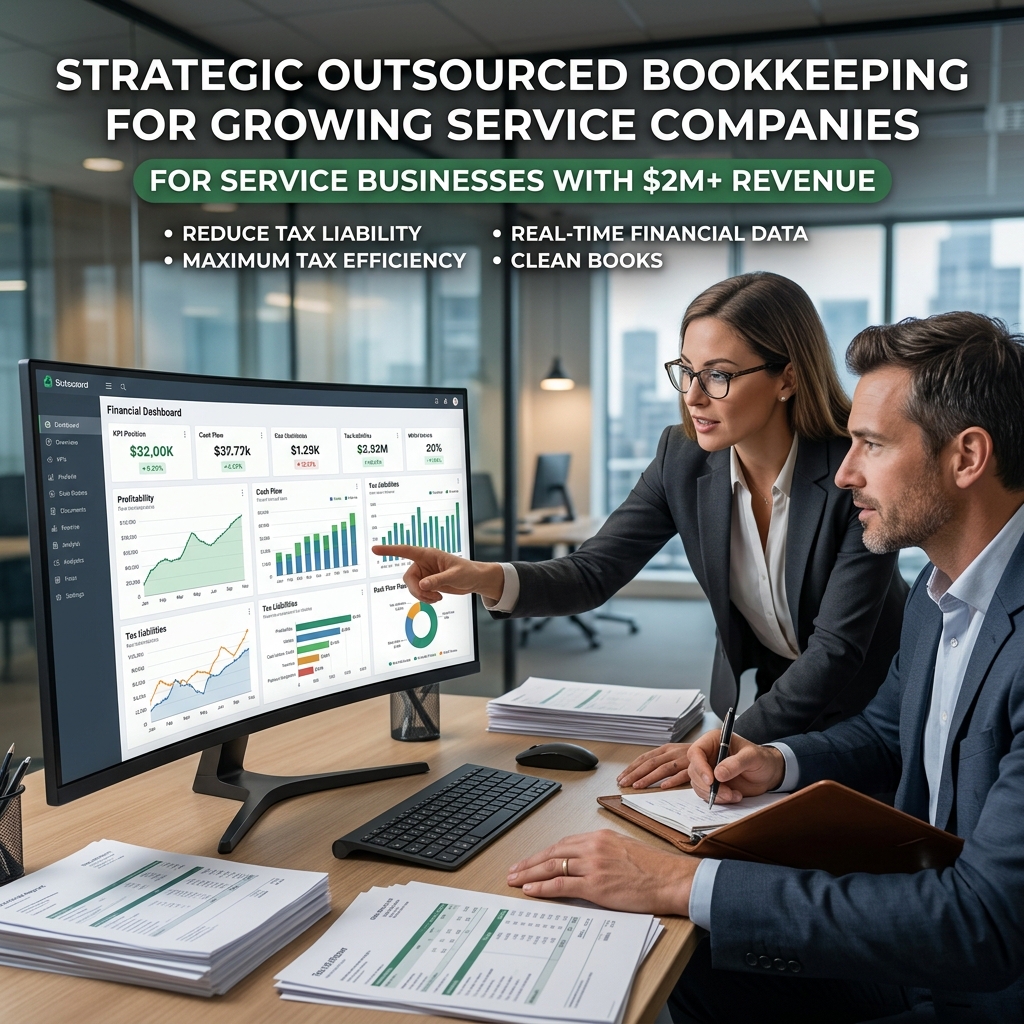
Strategic bookkeeping delivers real-time financial dashboards. You see revenue by service line, profitability by client, expense trends, and cash flow forecasts. That information lets you make decisions while you still have time to act on them.
Example: A service business owner discovers in November that one client relationship consuming 30% of time is only generating 8% of profit due to scope creep and underpricing. With real-time data, they can renegotiate terms, reduce involvement, or cut the relationship entirely before it becomes a bigger drain. DIY bookkeeping buries that insight until year-end review, costing months of lost opportunity.
Real-time data also protects your cash. You catch duplicate vendor charges, overpayments, or accounting errors before they stack up. You forecast cash needs three months out instead of scrambling when payroll comes due. You make staffing decisions based on accurate unit economics, not gut feel.
We build your reporting so you’re checking the numbers that matter to you—not sorting through compliance reports that obscure the insights hiding underneath.
Action step: What’s the one metric about your business you wish you understood better? That should be first on your dashboard.
The Connection Between Clean Books and Lower Taxes
Here’s the direct line: clean books enable better tax strategy, and better tax strategy reduces what you owe.
If your bookkeeping is disorganized, your tax professional spends time cleaning it up instead of optimizing it. That’s billable hours spent on remediation, not strategy. More importantly, they can’t recommend strategies they can’t see in the data.
Clean books reveal opportunities. Material participation in activities that looked passive. Legitimate business expenses that got lumped into miscellaneous. Timing strategies for income recognition. Entity structure options. Deductions for home office, vehicle, or equipment use that you didn’t realize applied.

We structure bookkeeping to surface these opportunities. We categorize transactions in ways that make tax implications visible. We run analysis quarterly so we spot patterns and anomalies that trigger strategy conversations, not year-end surprises.
The math is straightforward: we invest in strategic bookkeeping ($X per month), which enables better tax strategy (reducing taxable income by $Y), which cuts your tax bill by $Y times your tax rate. For a business owner in the 35-40% combined tax bracket, reducing taxable income by $50,000 is worth $17,500-$20,000 in tax savings.
That’s not unusual. That’s conservative for service businesses with the kind of revenue and profitability we work with.
This information is for educational purposes only and does not constitute tax, legal, or financial advice. Always consult with a qualified tax professional before implementing any tax strategy. Results mentioned are not typical and individual results will vary based on your specific situation.
Action step: Estimate your effective tax rate. If reducing your taxable income by $40,000-$50,000 is possible through better deduction capture and strategy, how much is that worth to you?
Building a Bookkeeping System That Scales With You
You started with simple accounting. As revenue grew to $2M+, your bookkeeping system didn’t evolve with you. Now you’re trying to run a sophisticated business on a small business bookkeeping foundation. That’s like driving a high-performance engine with a standard transmission.
We build systems that scale. That means your chart of accounts grows with service line diversity. Your reporting structure supports management decisions at the level of detail you need. Your automation handles volume without proportional cost increases.
Scaling also means your bookkeeping system becomes more strategic, not less. As business gets more complex, the need for organized financial information increases. You’re not just tracking transactions—you’re running scenario analysis, testing pricing strategies, and evaluating whether to enter new markets or service areas.
We design systems that grow with you. Client accounting integration, API connections to your project management platform, automated expense categorization, and quarterly strategy reviews built into the engagement.
The alternative is chaos. You outgrow your bookkeeper. You hire a part-time accountant. You add spreadsheets on top of spreadsheets. You’re in exactly the position most service owners are: operational complexity that your financial system can’t handle.
Action step: Map out what your bookkeeping needs will look like in 24 months if revenue grows 30-50%. Can your current system handle that, or will you be scrambling?
Turning Financial Chaos Into Strategic Advantage
Most service business owners treat bookkeeping as a compliance burden. We treat it as a competitive advantage.
When your books are clean and strategic, you can answer questions your competitors can’t. You know exactly which services are profitable. You understand cash conversion cycles. You spot trends in client behavior and market demand. You move faster because you’re not constantly digging through old transactions or reconciling discrepancies.
You also have the confidence to invest in growth. You’re not second-guessing pricing because you don’t know your true costs. You’re not afraid of hiring because you understand what each incremental dollar of payroll really costs you. You’re not anxious during tax season because your records are audit-ready and optimized.
That’s not just better bookkeeping. That’s a different operating environment entirely.
We’ve seen service business owners transform from tax-stressed, operationally blind, and perpetually behind to clear-eyed, confident, and proactive. The change doesn’t happen because they’re smarter. It happens because they finally have the right financial infrastructure underneath them.
That infrastructure is also what our CPA tax reduction services depend on. You can’t reduce taxes by 50% or more without knowing exactly what you’re reducing, where optimization opportunities live, and how changes affect your bottom line.
Action step: Identify one business decision you’ve delayed or gotten wrong because you lacked clear financial information. That’s your case for better bookkeeping.
Our Approach to Premium Bookkeeping Services
We don’t offer bookkeeping as a side service. We build bookkeeping as the foundation for comprehensive tax strategy and financial optimization.
Our process starts with a deep diagnostic. We understand your business model, revenue sources, expense patterns, and current tax situation. We identify gaps in your current system and opportunities you’re missing. We propose a bookkeeping structure designed specifically for your business.
From there, we manage the complete bookkeeping operation: bank reconciliation, expense categorization, payroll processing, financial reporting, and quarterly reviews. You get clean books, real-time dashboards, and strategic recommendations tied to data.
We also integrate bookkeeping with tax planning. Your quarterly reviews aren’t just financial statements—they’re strategy sessions. We’re looking at what’s working, what’s not, and what tax opportunities are emerging. We flag issues before they become problems.
The result: you know exactly what you’re spending, you understand your profitability, and you have a clear path to keeping more of what you earn.
Action step: Request a bookkeeping diagnostic call. We’ll review your current situation and identify what’s working and what’s costing you money.
Your Next Steps to Financial Clarity
If you’re a service business owner with $2M+ in revenue and $500K+ in taxable income, you have both complexity and opportunity. The right bookkeeping system makes that complexity manageable and that opportunity executable.
Start here: audit your current bookkeeping process. Is it helping you make better decisions? Are you confident your taxes are optimized? Do you have real-time visibility into profitability? If the answer to any of these is no, you’re operating with unnecessary costs and missed opportunity.
Reach out for a conversation. We’ll walk through your current situation, show you what’s possible with strategic bookkeeping, and outline a path forward. No obligation—just honest guidance about how better financial infrastructure could change your business.
Your business deserves bookkeeping that’s as sophisticated as the work you do. Let’s make sure you have it.
Ready to Cut Your Taxes – Schedule a game plan review and see how much you can save – https://join.elcpa.com/vsl-2
Frequently Asked Questions (FAQ)
How does strategic bookkeeping actually reduce our taxes?
We structure your books from day one with tax efficiency in mind, not just record-keeping. This means we’re constantly identifying deductions, expense categorizations, and timing strategies that most bookkeepers completely miss. When your financial data is organized strategically rather than haphazardly, we can pull back the curtain on legitimate tax reduction opportunities that directly impact your bottom line when tax season arrives.
What’s the difference between outsourcing bookkeeping to us versus using basic accounting software?
Software like QuickBooks is a tool, not a strategy. We use these tools, but we layer on active tax planning, real-time financial analysis, and proactive guidance that no software can provide on its own. You get clean, accurate books plus a team watching your numbers constantly to spot opportunities to keep more of what you earn. This information is for educational purposes only and does not constitute tax, legal, or financial advice. Always consult with a qualified tax professional before implementing any tax strategy.
How quickly will we see financial clarity and actionable insights from our bookkeeping system?
We typically have your books cleaned up and organized within the first 30 to 60 days, and from there you’ll start seeing real-time dashboards and monthly performance reports that actually mean something. Instead of wondering where your money went, you’ll know exactly where it’s going and where we can optimize. This shifts you from reactive firefighting to strategic decision-making that compounds over time.

Recent Comments