

The Hidden Cost of Being Reactive About Taxes
Most service business owners wait until March or April to think about their taxes. By then, the year is already done. The income is locked in. The deductions are missed. The strategy window has slammed shut.
This reactive approach costs you dearly. We’ve calculated what happens when a $3M service business owner operates without proactive tax planning: they typically overpay by $150,000 to $300,000 annually. That’s money already earned. Money that should stay in your pocket.
The math is brutal but avoidable. Every month you wait without a tax strategist in your corner, you’re leaving legal tax savings on the table. The difference between December and April 15th tax planning isn’t marginal. It’s catastrophic.
Your action step: Stop treating taxes as a once-a-year event. The real game happens in the eleven months before you file.
Why Your Current Tax Preparer Isn’t Enough
Your current tax preparer likely does one thing extremely well: they take the financial mess you hand them in January and turn it into a compliant return by April. That’s valuable. That’s also incomplete.
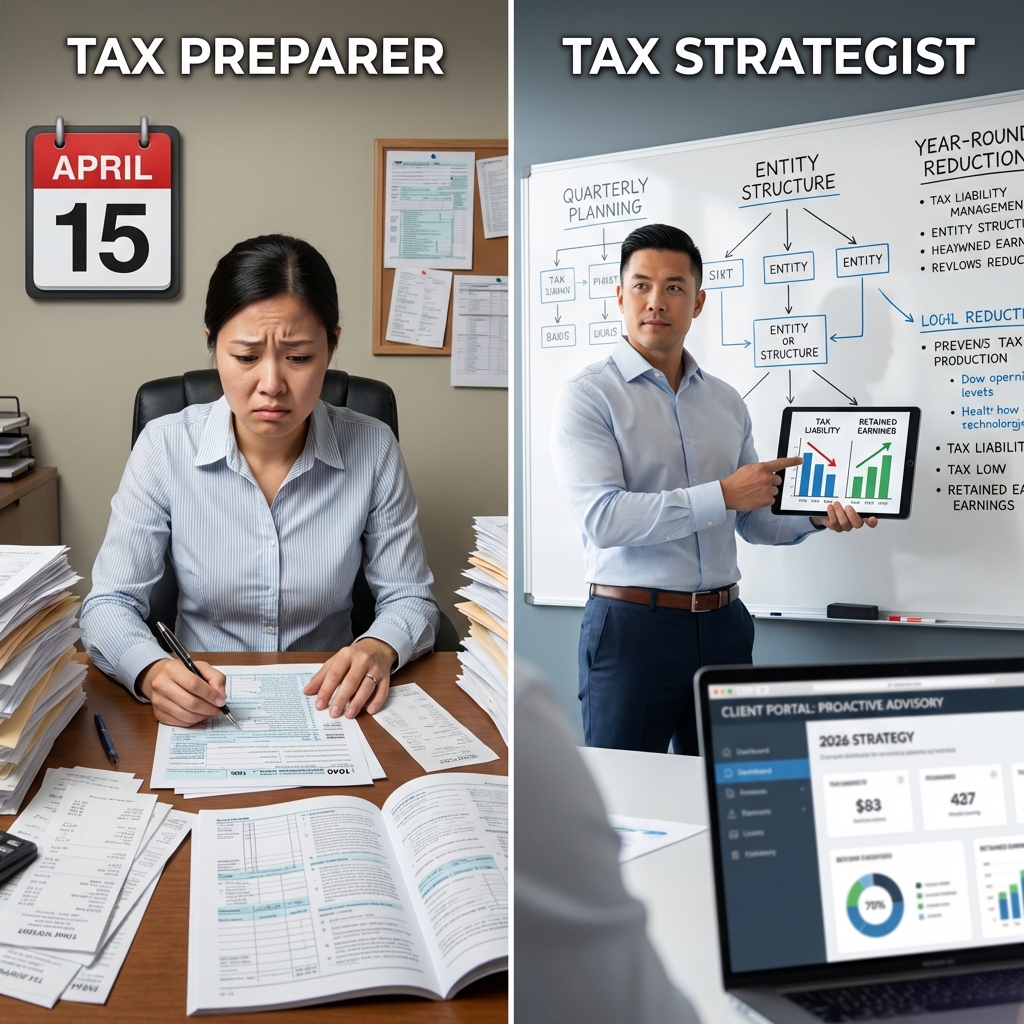
Tax preparers are historians. They document what already happened. They ensure you didn’t break any rules. They file your paperwork correctly. None of this saves you money in the current year.
A tax preparer answers the question: “Did I follow the rules last year?” A tax strategist answers: “What decisions can I make this year to legally owe less?” These are fundamentally different jobs requiring different skill sets and mindsets.
We’ve worked with hundreds of service business owners whose preparers never mentioned cost segregation, entity structure optimization, or business loss conversion strategies. Not because those preparers were incompetent, but because preparation and strategy require different expertise, different time investment, and different positioning in the client relationship.
Your preparer isn’t your strategist. Expecting them to be is like hiring a surgeon to be your personal trainer.
How We Define Tax Strategist vs. Tax Preparer
Let’s pull back the curtain on what we actually do.
Our tax preparers ensure your return is filed correctly, audit-proof, and compliant with current tax code. They know depreciation schedules. They understand passive loss rules. They file your paperwork with the IRS. This work is essential and non-negotiable.
Our tax strategists operate six months ahead of the return. They analyze your business structure, revenue patterns, expense timing, and risk tolerance. They identify opportunities to legally reduce your taxable income. They model scenarios. They stress-test strategies for sustainability. They convert passive losses into active losses using the 100-Hour Test. They unlock strategies through the Buy, Borrow, Die framework when it applies to your situation.
A strategist says: “Your rental property isn’t generating enough material participation hours. Let’s restructure how you manage it to hit the threshold.” Then the preparer documents that restructuring accurately on your return.
Both roles matter. They’re not interchangeable.

The Year-Round Advantage: Our Tax Advisory Approach
We structure our engagement so strategy happens continuously, not once annually.
Your quarterly tax planning sessions with our team aren’t prep meetings. They’re strategy sessions. We review your year-to-date numbers. We project your year-end position. We identify what’s working and what needs adjustment. We suggest tactical moves you can still make before December 31st. We quantify the impact.
In Q1, we’re setting expectations and identifying early opportunities. In Q2, we’re course-correcting based on actual results. In Q3, we’re stress-testing your year-end position and implementing time-sensitive strategies. In Q4, we’re executing the final moves and preparing your preparer to document everything correctly.
This rhythm ensures nothing slips through the cracks. No opportunity for a timed business expense in November gets missed because you were too busy. No entity restructuring stays undone because you didn’t know it was possible.
Between sessions, your designated CPA strategist stays available. You’re not a file number. You’re a client with a real relationship and direct access.
Proactive Tax Reduction: Where the Real Savings Live
Tax reduction strategies fall into four buckets. Each requires proactive positioning.
Timing and acceleration: Moving deductions forward or income backward within legal windows. Example: delaying a large invoice into January instead of December, or accelerating a planned equipment purchase into November. These moves require advance visibility into your cash flow. Your preparer can’t suggest them in April.
Entity optimization: Operating as an S-Corp, LLC, or partnership isn’t neutral from a tax perspective. The structure you chose three years ago might be leaving 15-20% unnecessarily on the table now. We model scenarios. We file elections. We sometimes recommend restructuring. This work happens mid-year, not at filing time.
Active loss conversion: Real estate holdings, partnerships, and side ventures often generate losses classified as passive. Passive losses have strict limitations. But if you can prove material participation (active involvement in business decisions), those losses convert to active status and unlock deductions. The 100-Hour Test is one measure. We map your actual participation. We document it. We protect it.
Strategic capitalization: Loans versus equity, cost segregation depreciation, bonus depreciation windows, R&D credit qualification. These require planning with your tax strategist and documentation with your business operations. By April, it’s too late.
Each strategy carries specific thresholds, documentation requirements, and risk profiles. We assess which apply to your situation and build a compliance defense as we build the tax savings.
How We Integrate Strategy with Preparation
Our process bridges strategy and preparation seamlessly.
Your tax strategist and tax preparer are the same firm, often with overlapping notes and shared understanding. When your strategist recommends an entity election in August, your preparer knows exactly why, how to document it, and what backup materials you’ll need. There’s no handoff. No translation loss. No second-guessing.
We also build a “tax defense file” as we execute strategies. When you implement a cost segregation study, we file the notice with your return. When you make an entity election, we include the IRS form. When you claim material participation, we include a summary of your participation documentation. The preparer isn’t discovering your strategy at filing time. The preparer is implementing what the strategist already vetted.

This approach also protects you. If an audit occurs, we’ve documented our thinking. We’ve supported our positions. We’ve shown you understood and intentionally chose a path, not stumbled into it by accident.
The Numbers: What Our Clients Keep vs. Lose
Here’s what we see in client outcomes. Results mentioned are not typical and individual results will vary based on your specific situation.
A service business owner with $2.5M revenue and $650K in taxable income typically operates with a 35-40% effective tax rate without strategy. That’s roughly $230-250K in federal and state taxes on $650K in taxable income. Add self-employment taxes, and you’re pushing 45%+ of your profit out the door.
With proactive strategy, that effective rate can drop 12-18 percentage points. A 15-point reduction on $650K in taxable income means $97,500 stays in your business instead of going to the IRS. Over five years, that’s half a million dollars. Not someday. This year. This decade.
Not every strategy applies to every client. Some clients operate in ways that limit opportunities. But across our service business client base, the median tax reduction is 30-40% of the original tax bill. The median annual savings is $85,000 to $180,000 depending on income level.
These numbers assume consistent income and business structure. They assume you implement strategy consistently, not as one-off moves. They assume your situation qualifies for the major strategies (entity optimization, loss conversion, etc.). But even conservative clients see material savings.
That’s the difference between having a strategist and not having one.
Your Quarterly Tax Planning Sessions with Our CPA Team
We’ve mentioned these sessions several times. Let’s spell out what actually happens in them.
You come with your year-to-date P&L and balance sheet. We bring our tax planning templates and scenario models. We walk through:
- How much income you’ve recognized to date and what you’re projecting for year-end
- What major expenses are coming (bonuses, equipment, contractor work, facility upgrades)
- What entity or structure changes might be beneficial now
- What tax laws changed in the last 90 days that affect you
- A numerical projection: if you do nothing, what do you owe? If you implement X strategy, what do you owe?
We show the math. We explain the compliance stance. We answer: “Can we actually do this, or is it risky?” Then we walk through implementation steps and timeline.
Most sessions surface 2-4 actionable opportunities. Some cost a little to implement (accounting work, IRS forms, legal structure changes). Most save far more than they cost to execute.
This is work your preparer cannot do. They don’t have your year-to-date numbers. They don’t have time available quarterly. They’re not incentivized to find tax savings; they’re incentivized to file accurate returns.
We’re incentivized differently. We want to keep more of what you earn.
From Strategy to Compliance: Our Seamless Process
After you decide to implement a strategy, here’s how we move from decision to documentation to filing.
Your strategist documents the strategic recommendation and the business rationale. Your business accountant or bookkeeper adjusts how transactions are recorded going forward. Your preparer ensures that adjusted treatment flows correctly into the tax return. And you keep a summary file of supporting documentation.
When you claim material participation on a real estate loss, we’ve tracked your hours. When you elect S-Corp taxation, we’ve filed Form 2553. When you depreciate equipment faster using bonus depreciation, we’ve attached the election to your return. The IRS sees a complete, consistent story.
We also conduct a year-end compliance review before filing. Your strategist, preparer, and accountant align on every material position. We stress-test the return for audit risk. We ensure you’re claiming what you should claim and supporting what you’re claiming.
This process takes two to four weeks longer than filing a return without strategy. But it cuts audit risk substantially and gives you confidence that every dollar of savings is defensible.
Why Service Business Owners Specifically Need Both Roles
Service businesses generate income differently than product businesses. You sell your time and expertise. You have fewer tangible assets to depreciate. You often have more flexibility in timing revenue and expenses. You’re vulnerable to S-Corp taxation opportunities your competitors aren’t using.
Many service business owners also have real estate holdings, partnership interests, or side ventures that create loss-generation opportunities. A consultant who owns rental properties has more tax complexity than a consultant with no other investments. A contractor with a partner has different entity options than a solo operator.
The IRS knows service businesses have these opportunities. They audit service business owners at higher rates than others. They’re specifically trained to challenge material participation claims, passive loss deductions, and entity elections.
You need both a strategist and a preparer because the opportunities are real, the compliance burden is real, and the audit risk is real. Walking this middle ground requires expertise in both directions.
Start Your Tax Transformation Today
The difference between overpaying taxes and keeping what you’ve earned often starts with one conversation.
If you’re a service business owner with $2M+ in revenue and $500K+ in taxable income, odds are real that we can identify 20-40% in tax reduction opportunities specific to your situation. The first step is straightforward: an initial tax strategy consultation where we review your current return, your business structure, and your goals.
We’ll ask detailed questions about your income, your entity structure, your real estate or partnership involvement, and your risk tolerance. We’ll analyze your last two years of returns. We’ll outline what’s possible. We’ll quantify the expected benefit. Only after that do we discuss engagement.
This information is for educational purposes only and does not constitute tax, legal, or financial advice. Always consult with a qualified tax professional before implementing any tax strategy. Results mentioned are not typical and individual results will vary based on your specific situation.
Your next move: Schedule a consultation with our tax strategy team. Let’s pull back the curtain on what you’re missing. Let’s show you specifically where the savings live. Let’s start your tax transformation so you can keep more of what you earn.
Contact us at Ed Lloyd & Associates, PLLC to begin. Your CPA team is ready to deliver both strategy and compliance, all year long.
Ready to Cut Your Taxes – Schedule a game plan review and see how much you can save – https://join.elcpa.com/vsl-2

Recent Comments