

Why Bookkeeping Errors Cost You More Than You Think
Bad bookkeeping doesn’t just create accounting headaches. It costs you real money in overpaid taxes, missed deductions, and audit risk.
We’ve analyzed hundreds of service business owners with $2M+ in revenue, and the pattern is brutal: the moment your financial records become disorganized, your tax liability climbs. A misclassified expense here. A forgotten deduction there. A contractor expense recorded as wages. These aren’t small errors. They compound into tens of thousands in unnecessary tax bills.
Here’s what most business owners don’t realize: the IRS scrutinizes service businesses harder than other industries. Why? Because service businesses have more subjective expenses and fewer tangible assets to track. That means sloppy bookkeeping doesn’t just create confusion. It waves a red flag at tax authorities.
The good news? Most of these mistakes are entirely preventable. Clean bookkeeping opens doors to legitimate tax strategies that service businesses overlook: converting passive losses into active losses, optimizing entity structure, maximizing deductible vehicle expenses, and strategic retirement contributions. We see businesses that simply switch to disciplined monthly bookkeeping and capture an extra $50K-$150K in tax savings annually, with zero changes to their actual business operations.
Your immediate action: Audit your current expense categorization this week. Pull your last 3 months of bank and credit card statements and honestly assess whether expenses are logged correctly and consistently.
Mistake 1: Commingling Personal and Business Expenses
This mistake might seem obvious, but we catch it constantly. You swipe your personal credit card for a business meal. You use your business account to pay a personal insurance premium. It feels harmless. It isn’t.
When personal and business finances mix, three things happen, none of them good. First, you’ll claim deductions you shouldn’t claim, which IRS auditors catch immediately. Second, you’ll miss deductions you should claim because you didn’t properly document business expenses. Third, you lose the ability to prove material participation in your business for tax purposes, which matters enormously for real estate losses and certain retirement strategies.
The IRS views commingled accounts as a sign of poor business practices. Auditors assume if you can’t keep finances separate, you probably can’t track true income or legitimate expenses either. Suddenly, they’re questioning everything.
Concrete example: A consulting firm owner we worked with had been using his personal checking account for 40% of business expenses while maintaining a business account for the remaining 60%. When his income spiked to $2.3M in taxable income, the IRS audit focused hard on whether business-account versus personal-account expenses were real. He lost $67K in deductions he legitimately earned because he couldn’t prove consistent business use. A separate, dedicated business account would have solved this instantly.
What to do next: Open a separate business checking account if you haven’t already. Move all business expenses there. Use your personal account exclusively for personal items. Yes, your business should occasionally reimburse you for out-of-pocket expenses, but those reimbursements should flow through the business account, documented properly.
Mistake 2: Inconsistent Expense Categorization and Documentation
You categorize a software subscription as “office supplies” one month, then “software” the next. A business meal appears as “meals and entertainment,” then “client entertainment,” then “travel.” Your bookkeeper uses three different descriptions for contractor payments from the same vendor.
This inconsistency destroys your financial clarity and creates audit risk simultaneously.
When expenses bounce between categories, your financial statements become unreliable. You can’t track spending by function. You can’t identify trends. You can’t make smart business decisions. And when an auditor digs into your returns, inconsistency screams “disorganized records,” making them more likely to dig deeper into every category.
The fix requires a discipline that most DIY bookkeeping systems enable but don’t enforce: create a chart of accounts specific to your service business and stick to it rigidly. Every expense gets logged to the same category, every time. Every vendor gets a consistent name. Every payment includes a description tied to your chart of accounts.
Quick example: A design agency we work with had “client expenses,” “project costs,” “design software,” “creative tools,” and “software subscriptions” all mixed throughout their bookkeeping. We consolidated them into clear, business-appropriate categories: Creative Software, Design Assets, Client-Reimbursable Costs, and Infrastructure Software. Suddenly their profit margins became visible, and they realized they were undercharging clients by $200+ per project. Same expenses. Better categorization. Transformed decision-making.
What to do next: Spend 90 minutes this week creating or refining your chart of accounts. Include only the categories your service business actually uses. Document the rule for what goes where (e.g., “All software subscriptions go here, regardless of purpose”). Share this with anyone who touches your bookkeeping. Consistency compounds value.

Mistake 3: Missing Revenue Recognition and Invoice Tracking
Revenue errors are killers because they touch both your income (what you owe tax on) and your expenses (what you can deduct). Track revenue poorly, and everything else falls apart.
Many service business owners we encounter don’t have a centralized invoice system. An invoice gets sent to a client, but no one tracks whether it was paid, when it was paid, or whether it was actually recorded in the books. Weeks later, a payment arrives and gets recorded as a miscellaneous deposit instead of being matched to the original invoice. Your balance sheet shows money in your account but your income statement doesn’t reflect the revenue. Your records become fiction.
Worse, if you miss tracking an invoice, you might not know you have uncollected receivables. That money is technically income you owe tax on (accrual basis), but you don’t actually have it in hand. You’re sitting on a tax bill for money you haven’t received yet.
Practical scenario: A marketing services firm we worked with had $340K in outstanding invoices at year-end that their bookkeeper never tracked as receivables. They paid taxes on income they hadn’t collected, then spent the next year chasing payments. Had they tracked invoices consistently, they would have known about those receivables and could have adjusted their estimated tax payments or their year-end strategy.
What to do next: Implement one centralized invoice management system this month. Every invoice gets issued through this system. Mark invoices as paid the moment payment arrives, matched to the invoice number. Export your receivables aging report monthly. Know exactly how much money is outstanding and how old those invoices are.
Mistake 4: Neglecting Quarterly Estimated Tax Payments
Most service business owners know they need to make quarterly estimated tax payments. But many skip them or underpay because they don’t know their true quarterly income.
Here’s what happens: You finish the year with high income, get a surprise tax bill you didn’t anticipate, and scramble to pay. The IRS then adds penalties and interest for underpaying estimated taxes. You’ve essentially given the government a free loan.
Worse, if your bookkeeping is a mess, you can’t even calculate your estimated tax liability accurately. You’re guessing. And guessing wrong costs you money either way: too high, and you’re loaning money to the government; too low, and you’re facing penalties.
Clean monthly bookkeeping is the only reliable way to know your true quarterly income and make accurate estimated tax payments. We calculate these payments based on actual financial data, not guesses. It prevents both surprises and penalties.
Real example: A consulting owner we advised was making estimated payments of $8K quarterly based on last year’s income. Her business grew 40% that year. Her actual estimated tax liability was $17K quarterly. She underpaid by $36K for the year, then faced $4,600 in penalties and interest. Accurate quarterly bookkeeping would have caught this and allowed her to adjust payments mid-year.
What to do next: Calculate your quarterly estimated tax liability now, not on April 14. If you don’t have clean bookkeeping, work backward from last year’s return and make conservative estimates. If your income is growing, increase your estimated payments. Review actual quarterly results each month and adjust future payments accordingly.
Mistake 5: Failing to Track Deductible Business Mileage
Vehicle mileage might seem like a small deduction. It isn’t. For service businesses, it’s often $8K-$20K annually in tax-deductible mileage.
The problem? Most business owners don’t track it. You drive to a client site, don’t write down the mileage, and assume you’ll remember it later. You accumulate miles throughout the year but never document them. At tax time, you estimate. The IRS doesn’t accept estimates. You miss the deduction entirely.
Even worse, if you’re audited and can’t prove your mileage with contemporaneous records (actual logs, not reconstructed lists), the IRS disallows the entire deduction. You lose thousands in uncaptured tax savings.
What qualifies? Mileage driving to client sites, business meetings, vendor meetings, and tax-related appointments. Driving to your office from home? Not deductible (commute). Driving home from client sites? Deductible (business purpose).
What to do next: Start a mileage log today. Record your odometer reading at the start and end of each business trip, note the business purpose, and keep it in your vehicle. Better yet, use a mobile app like MileIQ or Stride Health that automatically logs trips, and you confirm the business purpose. Review the log monthly and match it to your calendar to verify completeness.

Mistake 6: Poor Contractor versus Employee Classification
Misclassifying contractors as employees or vice versa creates cascading tax and legal problems.
Classify someone as a contractor when they should be an employee, and you’ve failed to withhold payroll taxes and may owe back taxes plus penalties. Classify someone as an employee when they should be a contractor, and you’re unnecessarily paying payroll taxes and making your labor costs noncompetitive.
The IRS uses a multi-factor test that’s not always obvious. They look at control (who sets hours, methods, tools?), economic reality (do they work for you exclusively or other clients?), and relationship (is it temporary or ongoing?). Get it wrong and you face audits, back-tax bills, and penalties that dwarf the difference in what you paid.
Concrete situation: A service firm we advised had three people classified as 1099 contractors. An IRS exam questioned the classification. One person worked exclusively for the firm, used the firm’s equipment, and followed the firm’s procedures. Clear employee misclassification. The firm owed $18K in back payroll taxes, penalties, and interest for three years of under-withholding.
What to do next: Audit your contractor relationships this quarter. For anyone earning $10K+ annually from your business, document the business case for contractor status. Do they control their own hours? Use their own equipment? Work for multiple clients? If the answer to all three is “yes,” contractor status is defensible. If you’re uncertain, consult a tax professional before an IRS exam forces you to pay and explain later.
Mistake 7: Delaying Monthly Financial Statement Reviews
This might be the easiest mistake to overlook because nothing explodes immediately when you skip it. But delayed financial statement reviews cost you strategically and tactically.
Tactically, if you review your profit and loss statement, balance sheet, and cash flow statement monthly, you catch booking errors fast. An incorrectly categorized expense, a duplicate invoice, a misclassified payment. Catch it in month 2, you fix it easily. Catch it in November, you’re scrambling through year-end tax planning with bad data.
Strategically, monthly reviews let you track performance against goals and adjust tax strategy in real time. You see that profits are tracking higher than expected by June, you can implement additional tax reduction strategies before year-end. You see cash flow is tight, you can plan for quarterly estimated tax payments without creating cash crisis.
What happens without monthly reviews: You reach October, tax planning season, and discover your bookkeeper recorded three months of expenses to the wrong cost center. Your P&L is unreliable. Your tax planning is built on fiction. You either delay tax work or work with incomplete data.
What to do next: Schedule one 30-minute monthly financial review. It takes your bookkeeper 10 minutes to prepare statements; it takes you 20 minutes to review them and ask questions. Ask: Is income trending as expected? Are expenses in line with budget? Are there unusual items that need explanation? This single habit catches 80% of bookkeeping errors before they become tax problems.
How Our Premium Bookkeeping Service Eliminates These Costly Errors
We designed our bookkeeping service specifically for service business owners who want clean, tax-strategic financial records without managing a full accounting team.
Here’s what we handle that DIY bookkeeping systems and generalist bookkeepers miss:
Dedicated Bookkeeper. You get a single point of contact who knows your business, your vendors, your expense patterns, and your tax strategy. Not a rotating staff. Not a generic system. A person who understands that your “client reimbursable expenses” need separate tracking because they affect your profitability calculations and tax planning.
Monthly Financial Statements. You receive a complete P&L, Balance Sheet, and Cash Flow statement every month. No guessing. No surprises. You know your true financial position before tax planning season arrives.
Tax-Intelligent Categorization. We don’t just record expenses. We categorize them in ways that support tax strategy and business decision-making. Contractor expenses are tracked separately from employee payroll. Vehicle expenses are isolated. Cost of goods sold is distinct from operating expenses. This granularity matters for every tax strategy we implement.
Bank and Credit Card Reconciliation. Every transaction is matched, explained, and categorized monthly. No loose ends. No missing deposits. No duplicate charges hiding in your records.
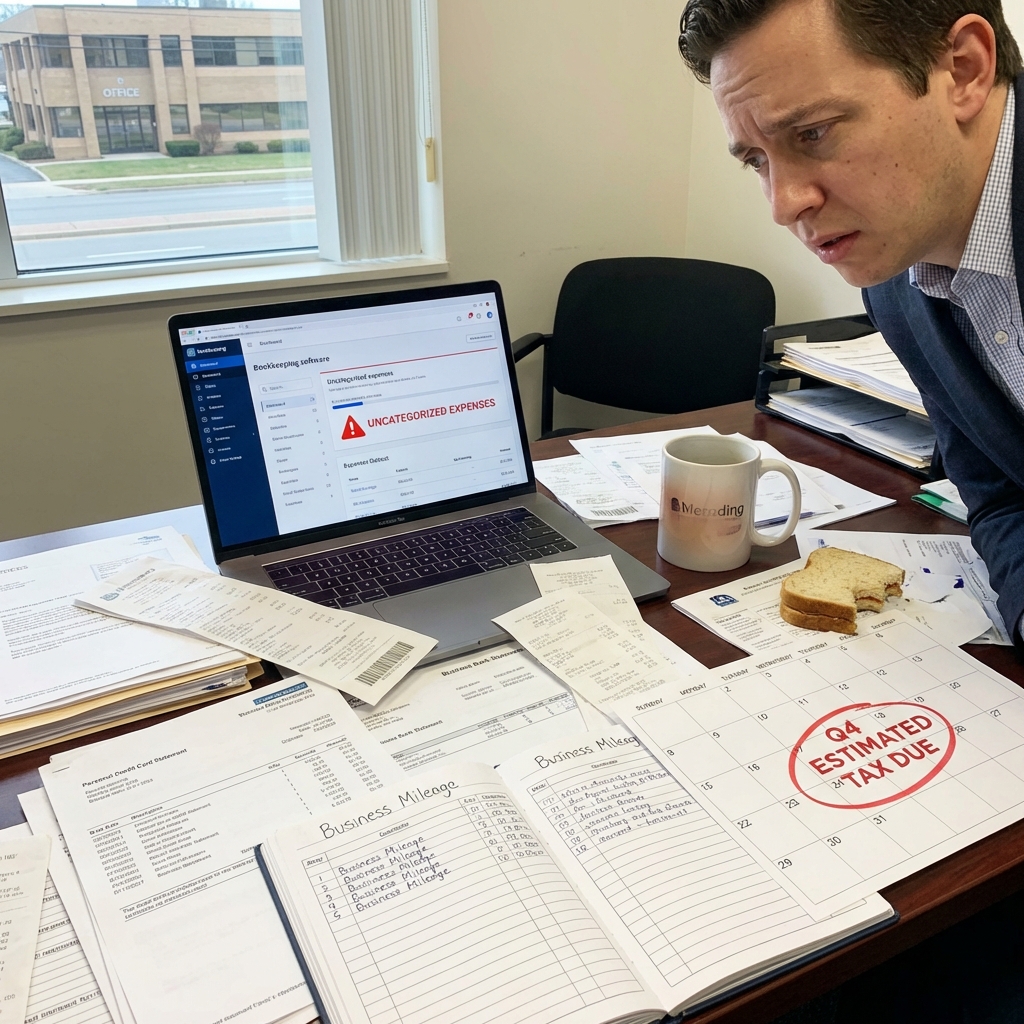
Expense Tracking and Documentation. We maintain the documentation standards required to defend every deduction, including mileage logs, contractor relationships, and invoice-to-payment matching that an auditor would accept immediately.
The result: your financial records become a foundation for aggressive, defensible tax strategies. When we identify a tax reduction opportunity, we’re not guessing at your income or expenses. We’re building strategies on clean, documented data.
Most businesses that switch to our premium bookkeeping service discover deductions and tax opportunities they were missing entirely, often worth $50K-$150K in additional annual tax savings.
Why DIY Bookkeeping and Basic Software Fall Short
We respect the DIY impulse. But bookkeeping software and generic bookkeepers have structural limitations for tax strategy.
Bookkeeping software like QuickBooks is powerful and cheap. But software doesn’t understand your business. It doesn’t catch inconsistencies. It doesn’t know that a “client entertainment” expense should be isolated from “meals” for tax planning purposes. It doesn’t flag that your mileage deductions seem low given your client base. A system follows rules; a strategist applies judgment.
Generic bookkeepers and offshore accounting firms excel at data entry. They’ll categorize expenses, reconcile accounts, and produce financial statements. But they’re not analyzing your tax position. They’re not identifying opportunities. They’re executing transactions, not strategy. Most have never worked with service businesses large enough to deploy real tax reduction strategies.
Here’s the real cost: when you use DIY or generic bookkeeping, you’re building financial records without tax strategy in mind. Then, when tax time arrives, you’re forced to work around poorly structured data. A $20K expense is in the wrong category. Contractor expenses are mixed with employee expenses. Mileage is estimated, not tracked. Suddenly, the tax strategies that could save you $80K require rewording your entire business structure.
We start with tax strategy, then design bookkeeping to support it. It’s backwards from how most accountants work, but it’s the only way to unlock meaningful tax savings for service business owners with substantial income.
What to do next: If you’re currently using QuickBooks or a generic bookkeeper, audit your financial statements for the last three months. Ask yourself honestly: Do I understand these numbers? Do I trust them? Do I know which expenses I can defend in an audit? If the answer to any is “no,” your bookkeeping isn’t supporting your business or your tax strategy.
Your Path to Tax-Efficient Financial Clarity
Clean bookkeeping isn’t just about compliance or audit defense. It’s the foundation for keeping more of what you earn.
We’ve worked with hundreds of service business owners who thought they’d optimized their taxes until they brought us clean financial records. Then we found strategies they’d never considered: converting passive real estate losses to active losses through material participation, restructuring entity ownership to reduce self-employment tax, timing revenue and expenses strategically across years, optimizing retirement contributions tied to actual business income.
None of those strategies work without bookkeeping you can trust. You can’t implement tax-efficient strategies on a foundation of guesses and estimated expenses.
Our CPA tax reduction services are built on premium bookkeeping because that’s the only way to deliver results. We analyze your complete financial picture monthly. We identify tax reduction opportunities as they emerge, not at year-end when it’s too late to implement. We adjust strategy based on actual performance, not projections.
If your bookkeeping is currently a pain point, a compliance obligation, or a mystery, the problem isn’t your bookkeeper. It’s the role bookkeeping is playing in your business. It should be your most powerful tool for understanding performance and reducing taxes. Instead, it’s become overhead.
We can change that. Start by auditing whether your current bookkeeping is actually supporting your financial goals. If it isn’t, let’s talk about how we structure bookkeeping differently.
This information is for educational purposes only and does not constitute tax, legal, or financial advice. Always consult with a qualified tax professional before implementing any tax strategy. Results mentioned are not typical and individual results will vary based on your specific situation.
Ready to Cut Your Taxes – Schedule a game plan review and see how much you can save – https://join.elcpa.com/vsl-2

Recent Comments