

The Tax Software Trap: Why DIY and Offshore Platforms Miss Your Real Savings
Service-based business owners making $2M+ in revenue shouldn’t be paying 50% of their income in taxes. Yet most are. We built Ed Lloyd & Associates on one simple conviction: the tax software industry has failed high-income business owners. Our approach pulls back the curtain on why and shows you what actually works.
Tax software is built for compliance, not for strategy. When you file through TaxHive, LessAccounting, or generic platforms, you’re getting a digital tax return filer, not a tax strategist. The software optimizes for one thing: accuracy at filing time.
Here’s what that misses: By April, your year is already over. The profit-taking decisions that could have saved you six figures happened months ago. You hired that employee, took that distribution, structured that contract, or left rental income passive without anyone modeling the tax consequence first.
Software platforms can’t execute strategies because strategies require judgment, knowledge of your specific business operations, and constant client communication. They can’t turn your passive rental loss into an active loss through material participation. They can’t structure service contracts as independent contractor arrangements to unlock self-employment tax savings. They can’t coordinate equipment purchases with cost segregation analysis.
We see this constantly. Clients come to us after using offshore-managed platforms and discover they’ve overpaid by $60K, $120K, sometimes more in a single year. The platform processed what they told it to process. No one was asking: “Are we missing anything?”
What to do next: If you’re using tax software today, pull last year’s return and ask yourself: Did anyone call me in September to discuss year-end strategy? If the answer is no, you’re operating in the compliance trap.
What We Discovered About One-Size-Fits-All Tax Solutions
We’ve worked with over 15 years of high-income service owners, and the pattern is identical. Every client tells us the same thing initially: “My accountant hasn’t called me about taxes since I filed.”
The reason is structural. Firms that use one-size-fits-all systems (whether software-based or just template-driven) can’t afford to have nuanced conversations with every client. They’d go broke. Their business model requires standardization. You get a tax return delivered in April. You’re grateful it’s done. You move on.
But you don’t move on from the missed opportunity. A business owner with $500K in taxable income who doesn’t have a proactive tax strategy is leaving money on the table every single quarter.
We discovered this by asking a different question: What if we built a practice around the assumption that tax planning happens year-round, not once annually? We restructured everything around quarterly planning meetings, real-time bookkeeping oversight, and ongoing strategy discussions.
The result? Our service-based business clients reduce their federal income tax burden by 50% or more compared to what they were paying under generic tax planning. That’s not typical, and individual results vary based on your specific situation. But it’s consistent enough that we built our entire firm model around it.
Actionable insight: Schedule a tax planning review for September of this year, not April. If your current advisor can’t do it, that’s your signal.
How We Structure Our Proactive Tax Reduction Differently
We operate on three pillars that software and traditional tax shops don’t.
Pillar 1: Bookkeeping and accounting services that feed strategy. We don’t just look at your books once a year. We have real-time visibility into your business operations through our integrated accounting services. This means we see your expense patterns, your revenue flow, and your contractor relationships as they happen. That real-time view lets us spot opportunities before they’re locked in.
Pillar 2: Quarterly performance monitoring and analysis. Every quarter, we run your numbers through our tax modeling software. We show you what your year-end tax liability looks like if nothing changes. Then we present the strategies that apply to your situation. You decide which ones to implement. This keeps you in control while giving us the runway to execute.

Pillar 3: Year-round tax strategist access. You don’t get a return from a software system. You get a relationship with a tax strategist who knows your business deeply. We answer tactical questions as they come up: “Should I make that equipment purchase now or wait?” “If I hire this person as a 1099 versus W2, what’s the tax impact?” “Does this business activity still qualify as passive or have we crossed into material participation?”
This structure costs more than TurboTax. It costs less than a Big 4 firm. More importantly, the savings we capture typically exceed our fee by 3x to 5x on average for service-based owners in our target range.
The Five Advanced Strategies TaxHive Cannot Execute
Software platforms can calculate deductions. They can’t execute strategy. Here are five advanced tax reduction approaches that require a live strategist and deep business knowledge.
1. Cost segregation and accelerated depreciation. This requires a detailed fixed-asset schedule, engineer-level property analysis, and IRS documentation standards. A software system can’t initiate this. We do it as part of our performance monitoring.
2. Converting passive losses to active losses through material participation. The IRS has specific tests (the 100-Hour Test and activity-level participation requirements). Meeting them requires documented evidence of your involvement. Software can’t track this. We build participation documentation into your quarterly planning.
3. Self-employment tax optimization through entity structure selection. Whether you operate as an S-Corp, C-Corp, sole proprietor, or partnership has massive tax consequences. This decision requires understanding your industry, revenue predictability, and overall tax picture. Software defaults to whatever entity you’re already in.
4. Timing of income and expense recognition across tax years. In November, we analyze whether accelerating or deferring income or expenses helps your multi-year tax picture. This requires forecasting, not just historical data entry. Software works with what’s already happened.
5. Real estate passive loss suspensions and carryforwards. If you own rental properties and service business income, coordinating these to unlock suspended losses is complex. It requires tracking basis, at-risk amounts, and passive activity groupings. Software can’t strategize this connection.
These aren’t exotic strategies. They’re standard approaches for high-income business owners. But they require someone who understands your business well enough to recommend them and document them properly for audit defense.
Why Your Dedicated Tax Strategist Matters More Than Software
Here’s the uncomfortable truth about tax software platforms: they’re designed to be audit-proof, not tax-proof. There’s a difference.
Audit-proof means the return is formatted correctly, the math works, and the numbers reconcile. Tax-proof means you’ve paid the minimum legal amount of tax on your income.
Software achieves audit-proof. A strategist achieves tax-proof.
When you work with us, you’re getting someone who understands not just your numbers, but your business model. We know which service contracts are worth restructuring, which equipment purchases matter for tax timing, and which activities need better documentation to sustain aggressive positions if audited.
This matters enormously at audit time. We’ve defended clients in IRS audits where the exam agent wanted to recharacterize their passive losses as suspended. Why? Because we had documented, contemporaneous evidence of material participation that software-filed returns simply don’t include. Those audit defenses have saved clients six figures.
Software can’t provide that. A dedicated strategist can.
Here’s what changes: You go from hoping the IRS doesn’t audit you to having the documentation to win if they do.
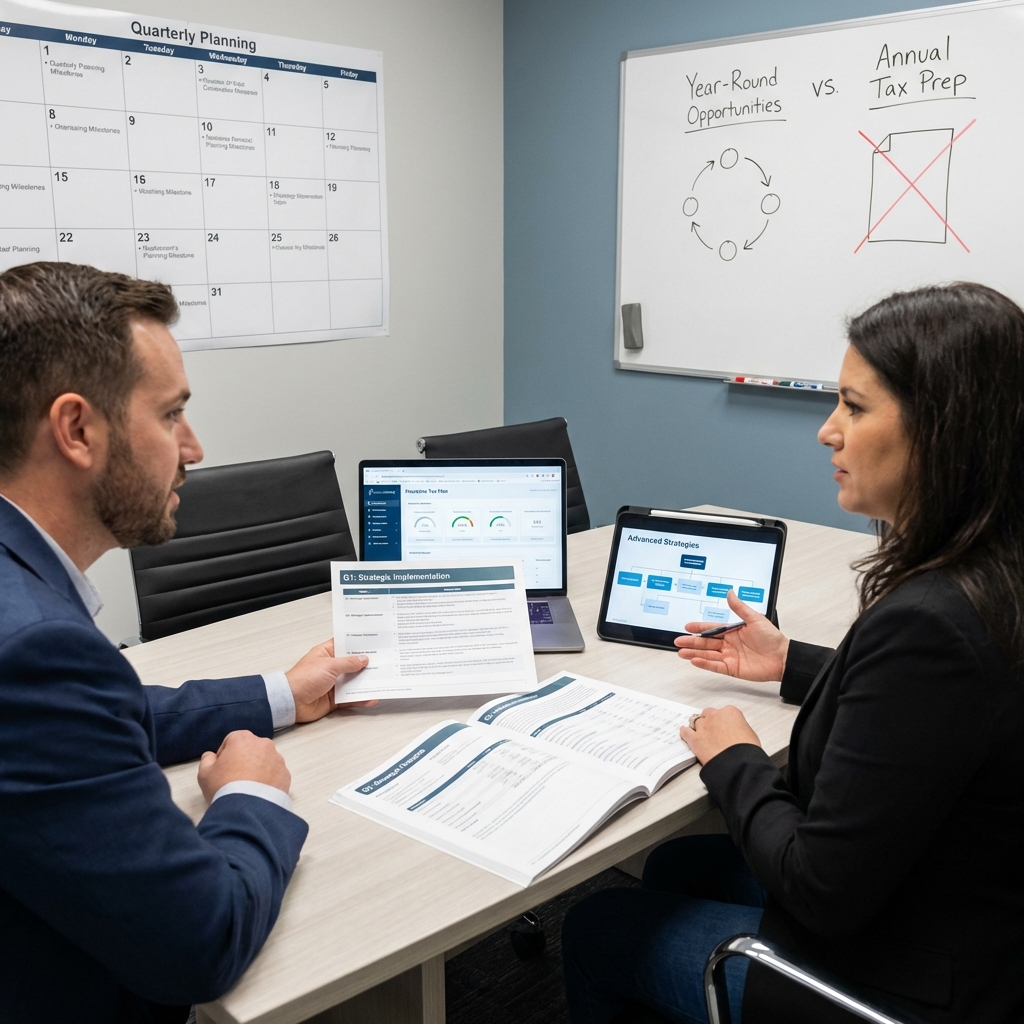
Our Quarterly Planning Process That Captures Year-Round Opportunities
This is how we’re different from annual tax shops and entirely different from software platforms.
In January, we meet with you to discuss the prior year results and your forward business plan. We identify which strategies worked and which didn’t.
In April, we review your first-quarter profitability and model your year-end position under three scenarios: status quo, aggressive tax reduction, and maximum tax reduction.
In July, we review your mid-year numbers and adjust. This is when equipment purchase timing becomes real. This is when we decide if cost segregation makes sense. This is when we verify that passive activity strategies are still on track.
In October, we lock down year-end planning. We finalize timing on distributions, bonuses, charitable contributions, and retirement plan funding. We run the numbers. We execute.
The software filing happens in April of the following year. But the strategy was locked in by October of the prior year.
Most business owners never see this rhythm. They see one tax return in April, then nothing until November when they start thinking about the next year. We’ve already been planning for three quarters by then.
Your move: If your current advisor hasn’t contacted you in the last 90 days about your 2025 year-end planning, you’re behind.
How We Turn Passive Losses Into Active Deductions
This strategy alone has saved our clients hundreds of thousands of dollars collectively. It’s also the one most commonly missed by software-driven accounting.
Here’s the scenario: You own a rental property and you run a service-based business. Your rental property generates a $40K loss annually. Normally, that loss is passive and suspends. It carries forward until you sell the property or have passive income to offset it. Meanwhile, your service business generates $500K in income, which you pay ordinary income tax on.
But here’s the opportunity: If you can establish material participation in the rental property, that loss becomes active. You can deduct it directly against your service business income in the year you generate it.
Material participation sounds vague. It’s not. The IRS has specific tests. The simplest is the 100-Hour Test: you must participate in the activity for more than 100 hours during the year and your participation must be substantial and ongoing.
Software can’t track this. It doesn’t know how many hours you spent on maintenance calls or reviewing tenant issues. It doesn’t know that you’re the one reviewing rental agreements and managing contractor relationships.
Here’s what we do: We help you document your material participation. We track activities quarterly. We build the evidence now so we can defend the position later if audited. Then we convert those passive losses into active deductions that save you real money in the current tax year.
This information is for educational purposes only and does not constitute tax, legal, or financial advice. Always consult with a qualified tax professional before implementing any tax strategy. Results mentioned are not typical and individual results will vary based on your specific situation.
The Audit Risk Reduction That Comes With Our Advisory Model
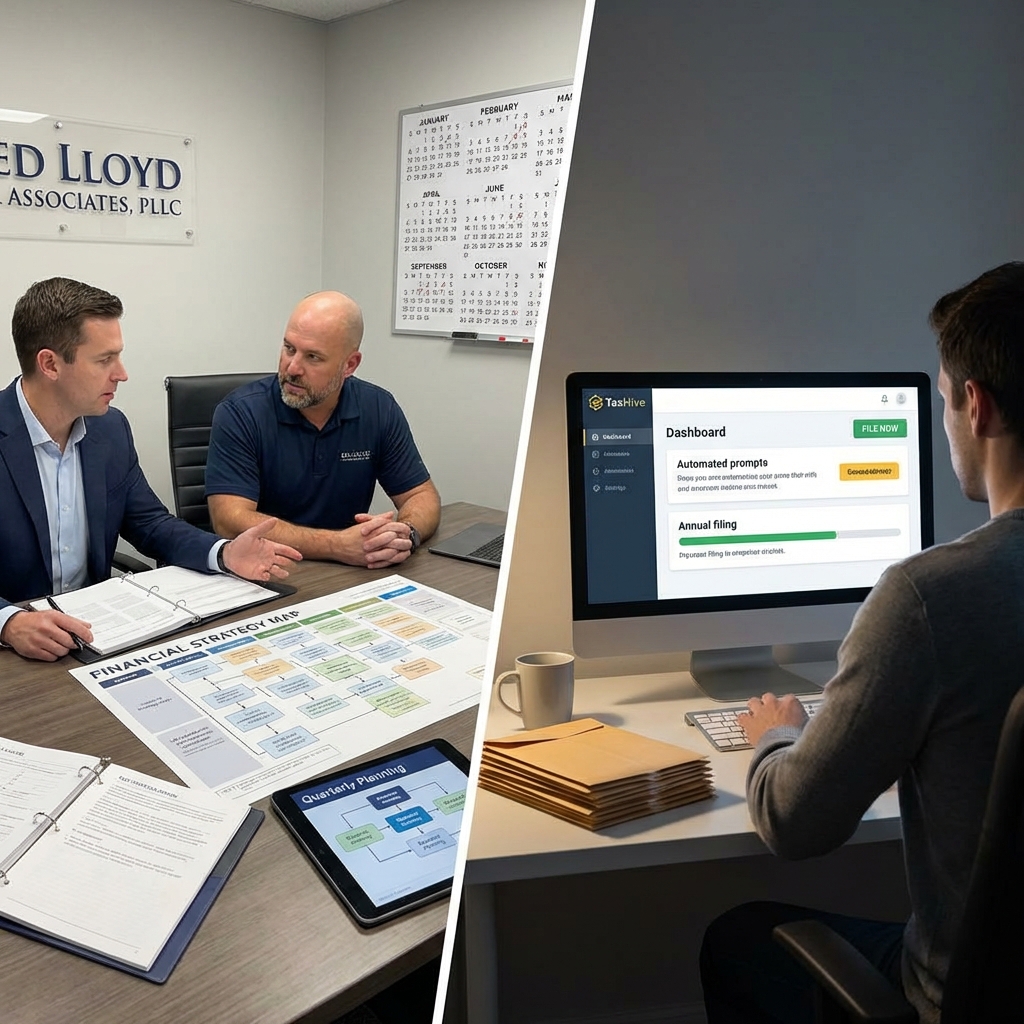
Here’s what keeps most high-income business owners up at night: “If I’m aggressive on taxes, will the IRS audit me?”
The answer is: It depends on how aggressive you are and whether you have the documentation to defend it.
Software platforms don’t account for audit risk. They file what you tell them to file. If you take a position the IRS doesn’t like, you’re on your own. You have no documentation trail of how the position was derived or what business judgment supported it.
We take audit risk seriously. When we recommend a strategy, we do so with full knowledge of IRS audit patterns in your industry and income level. We then make sure you have the documentation to sustain that position if audited.
For example: If we recommend converting a rental loss to active through material participation, we’re not just relying on your assertion that you spent 100 hours. We’re documenting that. We’re tracking activities. We’re building a record that holds up under IRS scrutiny.
This dual focus on tax reduction and audit defense is what separates proactive planning from reckless aggression. We pursue the first. We avoid the second.
What High-Income Service Owners Actually Need From Their CPA
After 15 years in this space, we know exactly what matters to service business owners making $2M+ in revenue.
You don’t need someone who processes your tax return well. You need someone who prevents you from overpaying in the first place. You don’t need annual contact. You need quarterly engagement that keeps tax consequences front-of-mind when you’re making business decisions. You don’t need generic advice. You need strategies specific to your business model, your revenue pattern, and your personal financial goals.
You need someone who understands both your operational business and your tax situation. That’s rare. Most CPAs are good at one or the other, not both. We’re intentional about building both capabilities.
Finally, you need someone who owns the outcome. Not a software company that gets paid whether you save money or not. An actual person or team whose reputation is built on the tax savings they deliver.
Your Next Step: From Overpaying to Keeping What You Earn
If you’re a service business owner with $2M+ in revenue and $500K+ in taxable income, you’re likely overpaying federal income tax. Not by a little. By tens of thousands or more annually.
That’s not an accident. It’s a structural problem with how most tax planning works in this country. Annual-only planning, one-size-fits-all software, and advisors who don’t have time for strategy.
We built our CPA tax reduction services to solve that problem. We do quarterly planning. We provide real-time bookkeeping. We combine proactive tax strategy with audit defense documentation.
The result? We help service-based business owners reduce their income tax burden by 50% or more. That’s not typical. Individual results vary based on your specific situation. But we’ve seen it consistently enough that we stake our reputation on it.
Here’s what we suggest: Schedule a brief conversation. Walk us through your current tax situation. We’ll show you whether there’s opportunity in your specific numbers. If there is, we’ll outline the first steps. If we’re not a fit, we’ll tell you that too.
The point is simple: You shouldn’t pay more tax than the law requires. Let’s figure out if we can help you keep more of what you earn.
Ready to Cut Your Taxes – Schedule a game plan review and see how much you can save – https://join.elcpa.com/vsl-2

Recent Comments